
Key words
Quantum Navigation: The utilization of Earth’s magnetic field in navigation
Introduction
In many ways, birds function like any other animal on the planet. They eat, sleep, and reproduce. However, their complexities are astounding. They fly. And they navigate using quantum, the thing that many know exists, few understands. So, how do birds utilize this complex mechanism? It’s simpler than you think.
Why and when do birds migrate?
Birds migrate with the seasons to areas with more comfortable climates and food resources. They start to search for nesting locations that are best suited for breeding with plenty of food. However, birds that want to breed generally prefer the places where they grew up. (yes, they even can remember where they were born!). Here are the main reasons for their migration.
Food sources: Food shortages are one of the main reasons for migrating. Food sources are renewed in the northern regions and birds migrate to more resources in the spring.
Climate: Each species of bird shows different resistance against different types of climate. But for birds that are not resistant to too cold or too hot climate conditions, the situation is different. They have to migrate to a more appropriate region.
Predators: Every organism needs rich food sources, and every animal wants to be able to raise its offspring and continue its lineage. This means they must avoid predation. In this case, the birds migrate away from potential predators. But they also know that there is no habitat without predators. Therefore, when they cannot escape from the predator, they try to build their nests in a way that the predator cannot reach or find. For example, the bird species Anthoscopus minutus, hides its eggs in a hole that only it can pass through to protect eggs from predators.
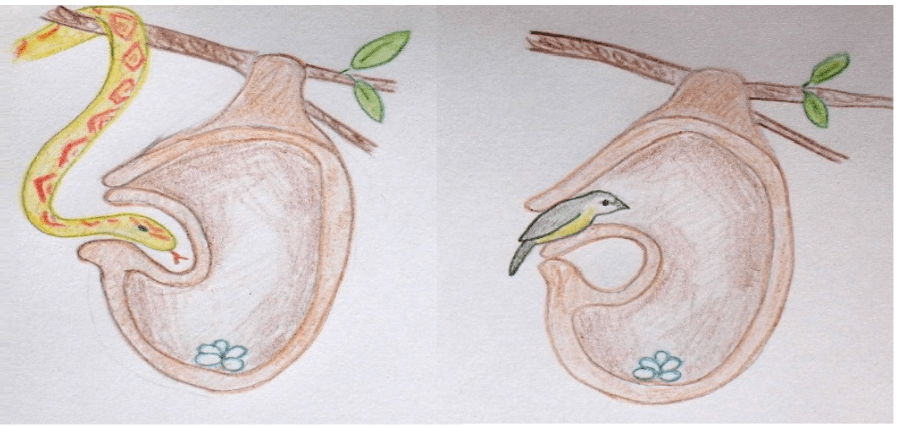 Illustration of a Anthoscopus minutus nest
How do birds find their way?
Studies by ornithologists and other researchers have shown that migratory birds migrate between two extremes by following the same route. Moreover, the distance between these two extremes can be thousands of kilometers. On the other hand, sometimes we humans even have a hard time finding our way home. So what is the secret behind these superior navigational abilities of birds?
For many years, researchers believed that birds find their way by following visual markers. However, today, according to ornithologists: visual markers, special sounds, different smells, and even social cues play a role in how birds find their way.
Characteristic smells can help birds recognize places they have visited before, like humans.
Imagine that you are flying thousands of meters high, you can see natural landforms such as rivers, forests, mountains, just like looking at a map, and you can find your way by looking at this natural map. In addition, since landforms do not change very quickly, they can use it effectively throughout life. Young birds are thought to acquire this mental map through social learning, traveling with parents or other adult birds. However, birds can find their way during night flight too. Because sky markers, such as stars, the Moon and the Sun can also guide migratory birds just like ancient sailors. In other words, there is more than one sole factor in how birds know which way to go.
Of course, these excellent talents bring to mind the thought that “there must be something else”, which is not an empty delusion, but is based on a “navigation” ability that was discovered decades ago. With this mysterious ability, some creatures can sense or see the magnetic field lines of our planet. Researchers now know that birds combine their magnetic compass and their eyes together, using them simultaneously to create the perfect navigation tool that helps them to find their way home. Research continues on how this magnetic field sensor, which we liken to the natural compass, can be found in the cells of the bird’s retina and how it works. In fact, this field is one of the new fields of quantum biology.
Scientists believe that many animals can sense and use the Earth’s magnetic field without a doubt, and people may too have a magnetic sense. But how this quantum sixth sense might work remains a mystery for now. Some researchers believe that animal’s sense this due to magnetite, an iron mineral, while others believe it is due to cryptochrome, a protein found in the birds’ retinas. What is cryptochrome, exactly? Cryptochromes are proteins that can be excited and triggered when they are exposed to blue light. These proteins are essentially light-activated switches. We know that some subset of these cryptochromes are called Cry1, Cry2, and Cry4. When scientists observed these proteins, the energy level of the protein called Cry4 was stable for 1 year until the migration season came. When the migration season came, the energy level of this protein in birds was at its highest. However, no such change was observed in non-migratory birds. So this protein gives birds a kind of biological magnetic compass capability. All of these are found in migratory birds’ eyes, especially in an area of the bird retina that receives a lot of blue light.
According to Joe Kirschvink from the California Institute of Technology in Pasadena, magnetite has been found in bird beaks, fish noses, and even the human brain, which is highly sensitive to magnetic fields. So do we actually have this quantum ability? Partly yes, although it is too early to answer that concretely. This ability is implicit, so it is located on the unconscious side of our brain. Studies on this subject continue and open up a new topic: How can we consciously use this unconscious ability? In evolutionary terms, the reason why we are deprived of this ability while our ancestors were able to use it is another matter of curiosity. Scientists have two guesses on this subject. People may no longer need such a capability in the modern world, or our internal compass may be disrupted because we are surrounded by too many and powerful magnetic fields such as MRI scanners and headphones.
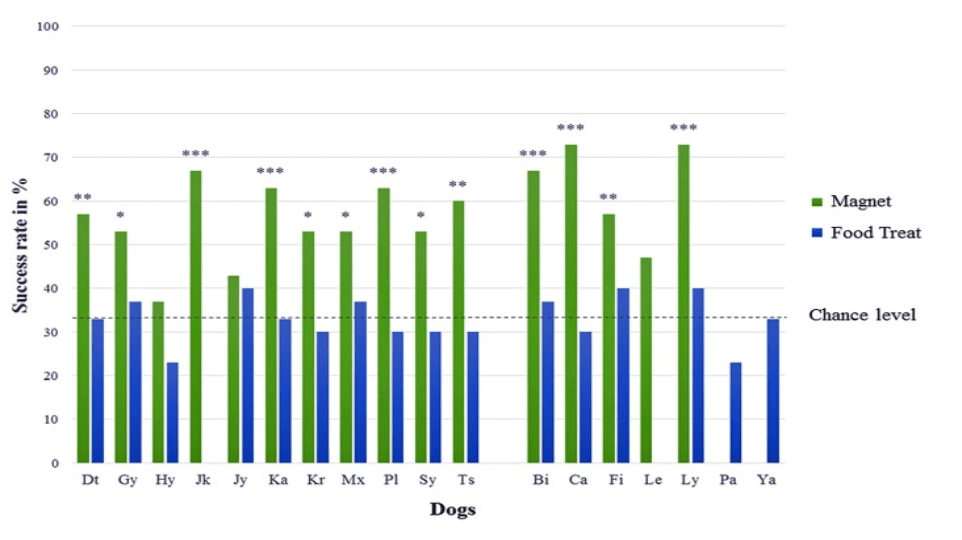
Current research shows that it’s not the iron in bird’s beaks that serves as a magnetic compass, instead a protein in their eyes that allows them to “see” Earth’s magnetic fields. Still, it is now an accepted fact that many animals sense magnetic fields. Birds, bees, turtles, sea turtles, fish and other migratory animals dominate the list; it sounds logical for migratory animals that travel the world to have a compass in their body for their journey. Unlike others, foxes use it to measure distances against their prey rather than just direction. As a result of ongoing research in recent years, researchers have found that slower creatures are also on this list: snails, lobsters, worms, snails, frogs, and newts. Mammals actually have a partial place on this list. Animal behavior we often think of as “primitive” has quantum underlying behavior and they use the earth’s magnetic field lines. In studies, magnetic field lines are utilized by wood mice and mole rats to locate their nests, by cattle and deer to orient their bodies while grazing, and by dogs to point themselves north or south when urinating or defecating. Also it was discovered in a study of dogs trained to find bar magnets that dogs found bar-magnets rather than food treats.
If we go back to birds, as I explained, Ferromagnetic particles allow the bird to determine their direction according to the lines of the Earth’s magnetic field. To test this, scientists placed a strong magnet in the birds’ bodies, which would neutralize the ferromagnetic particles, and observe whether the birds’ navigational abilities continued. They then understand that the magnet-bound birds are unable to navigate. Magnetite (Fe3O4), an iron-rich mineral discovered in their necks, was the cause of this, as it turned out. Just as this magnetic bar causes birds to lose their way, how do the magnetic fields created by humans affect birds? For this reason, the issue of how migratory birds find their way is still a very critical research topic. Because human-made radio towers, power lines, as well as other structures can affect birds’ sense of magnetic fields. These unnatural magnetic fields can disrupt the migration patterns of bird populations, leading to the endangerment of numerous species.
Although it has become clear that birds can fly thousands of kilometers with their incredible ability to navigate using their tiny brains, there are still thousands of open-ended questions about migratory birds, and research in the field of quantum biology continues at full speed to explain them.
References:
Powell, H. (2022, June 1). The basics of bird migration: How, why, and where. All About Birds. Retrieved August 31, 2022, from https://www.allaboutbirds.org/news/the-basics-how-why-and-where-of-bird-migration
Jones, B. (2022, January 27). A new theory helps explain the epic mystery of Bird Migration. Vox. Retrieved August 31, 2022, from https://www.vox.com/down-to-earth/22901324/birds-migration-navigation-earth-magnetic-field
Mayntz, M. (2019, October 2). Exactly why do birds bother migrating? The Spruce. Retrieved August 31, 2022, from https://www.thespruce.com/why-do-birds-migrate-386453
@worldbirds32. (2021). Cape Penduline-tit (Anthoscopus minutus). Twitter. photograph. Retrieved August 31, 2022, from https://twitter.com/worldbirds32/status/1465445138797318163/photo/1.
Trịnh, M. (2018, September 15). How birds use quantum mechanics to navigate the world (quantum biology 3/3). Medium. Retrieved August 31, 2022, from https://michaeltrinh18.medium.com/how-birds-use-quantum-mechanics-to-navigate-the-world-quantum-biology-3-3-bfd06a335be3
Starr, M. (2018, September 1). Birds can see Earth’s magnetic fields, and now we know how that’s possible. ScienceAlert. Retrieved August 31, 2022, from https://www.sciencealert.com/birds-see-magnetic-fields-cryptochrome-cry4-photoreceptor-2018
Hore, P. J. (2022, April 1). How migrating birds use quantum effects to navigate. Scientific American. Retrieved August 31, 2022, from https://www.scientificamerican.com/article/how-migrating-birds-use-quantum-effects-to-navigate/
Wiltschko, W., Munro, U., Ford, H., & Wiltschko, R. (1993, August 5). Red light disrupts magnetic orientation of migratory birds. Nature News. Retrieved August 31, 2022, from https://www.nature.com/articles/364525a0
Hand, E. (2016, June 23). Maverick scientist thinks he has discovered a magnetic sixth sense in humans. Science. Retrieved August 31, 2022, from https://www.science.org/content/article/maverick-scientist-thinks-he-has-discovered-magnetic-sixth-sense-humans
Yong, E. (2019, November 20). Turtles use the Earth’s magnetic field as a global GPS. Discover Magazine. Retrieved August 31, 2022, from https://www.discovermagazine.com/planet-earth/turtles-use-the-earths-magnetic-field-as-a-global-gps#.VwcDjT_-U_A
Phillips, J. B., Muheim, R., & Jorge, P. E. (2010, October 1). Behavioral perspective on the biophysics of the light-dependent magnetic compass: A link between directional and spatial perception? The Company of Biologists. Retrieved August 31, 2022, from https://journals.biologists.com/jeb/article/213/19/3247/9744/A-behavioral-perspective-on-the-biophysics-of-the
Marshall, M. (2011, January 12). Foxes zero in on prey via Earth’s magnetic field. New Scientist. Retrieved August 31, 2022, from https://www.newscientist.com/article/dn19945-foxes-zero-in-on-prey-via-earths-magnetic-field/
YouTube. (2019). Can Humans Sense Magnetic Fields? YouTube. Retrieved August 31, 2022, from https://www.youtube.com/watch?v=dg3pza4y2ws
Martini, S., & Begall, S. (2018, December). Dogs can be trained to find a bar magnet – researchgate.net. Dogs can be trained to find a bar magnet. Retrieved August 31, 2022, from https://www.researchgate.net/publication/329716913_Dogs_can_be_trained_to_find_a_bar_magnet