
Six designs for the next generation of nuclear power have been approved by the Generation IV International Forum, an international organization created in 2001 with the goal of deploying 4th generation nuclear reactors for industrial use by 2030 (“Generation IV International Forum”). These designs aim to harness nuclear fission for electricity in a safer and more scalable way – some small enough to be transported by tractor trailer – than ever before (Nunez et al.). These designs should also bring down the cost of nuclear power, which now stands between $0.097 kW⋅h to $0.136 kW⋅h, in order to make it more competitive with the cost of other green energies such as offshore wind (Howard). Nuclear energy is a very carbon-efficient method for electricity production, so its development is critical as humans look to meet growing energy demands while reducing our carbon footprint in the coming decades. Let’s take a look at the most innovative and acclaimed reactors approved by the international forum.
Standard Reactor Mechanism (Gen III Reactor)
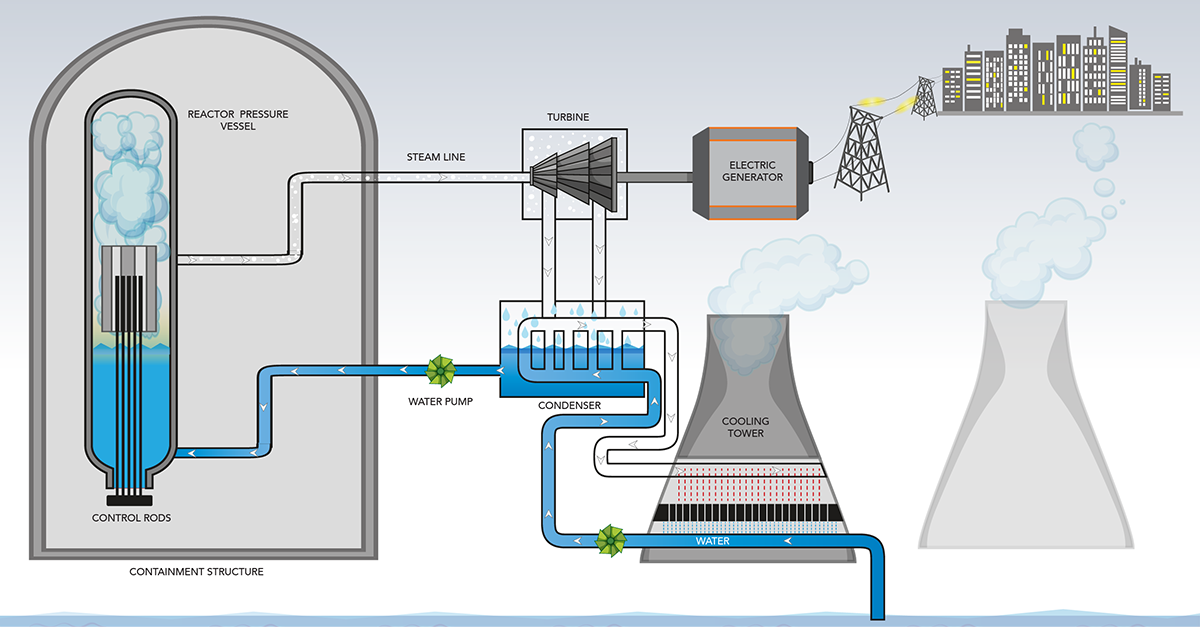 Standard Nuclear Reactor
Sourced from DoE
Let’s first discuss the standard mechanisms for current Gen-III nuclear reactors. Within the pressurized reactor (shown on the left side of the below image), Uranium rods undergo nuclear fission when high-energy neutrons are shot at them. Here, the Uranium nucleus splits (fisses) releasing high quantities of energy in the form of heat. In a controlled reactor, the rods will heat to roughly 300 degrees celsius (“Nuclear Process Heat for Industry”). These heated rods boil the water in which they are submerged. Steam is captured and spins a turbine, producing electricity. However, some downfalls exist with the current technology which is used in 93 reactors across the US and 440 across the world (“Plans for New Nuclear Reactors Worldwide”). For example, malfunctions can cause nuclear meltdowns if the fissile uranium is not properly cooled. The Fukushima Daiichi nuclear disaster in March 2011 occurred when damage from a tsunami disrupted the flow of water into the pressurized reactor, and without the water acting as a coolant the fissile uranium heated to temperatures comparable to those of our sun (“Fukushima Daiichi Accident”). At such temperatures, the radioactive fuel within three reactors partially melted through the containment structure and exposed radioactive material to the Pacific Ocean and open air (“Fukushima disaster: What happened at the nuclear plant?”). Other downfalls of current nuclear reactors are the quantity of solid radioactive waste produced, the expensive upfront costs of constructing plants, and the fact that Uranium is technically a nonrenewable resource. Gen-4 reactors look to address all of these concerns.
Molten Salt Reactor (MSR)
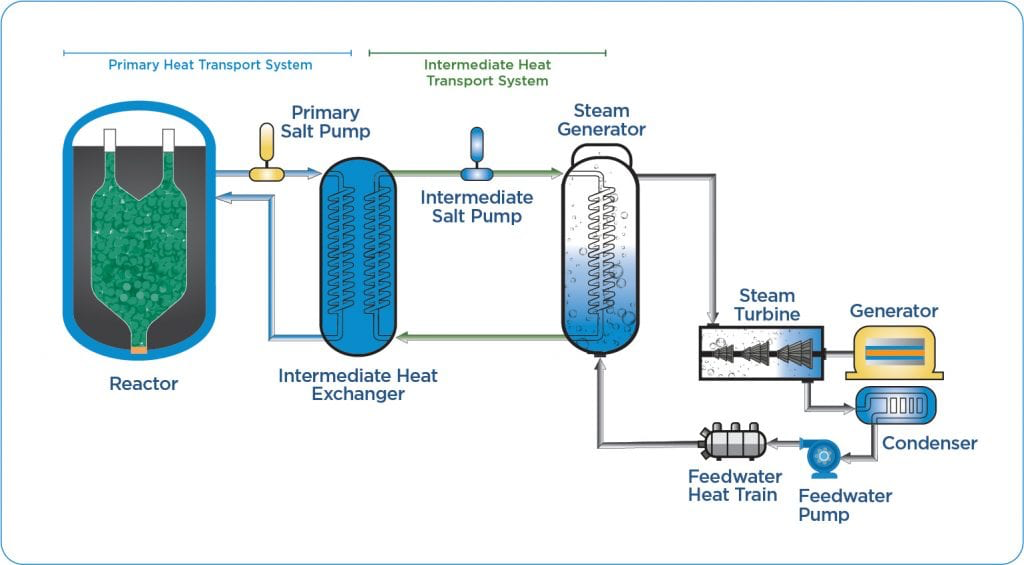 Molten Salt Reactor Design Prototype
Sourced from POWER Magazine
The Molten salt reactor is unique in that rather than using uranium rods as fuel, they dissolve the fissile element within a liquid salt (usually lithium fluoride). Then, the liquid uranium, plutonium, or thorium infused salt are heated extremely hot ( ≈ 800 °C) – serving as both the fission reaction site and the coolant. The most prominent benefits of MSR is that they operate at high temperatures and normal atmospheric pressure. High temperatures produce more turbine-spinning steam and electrical energy, and atmospheric pressure reduces the risk of a reactor meltdown as opposed to current reactors which operate under thousands of pounds of pressure. Additionally, by immersing the nuclear fission reaction within the coolant (salt) the chances of a meltdown dramatically reduce as water does not need to be constantly pumped to the site of the reaction to control it. Terrestrial Energy, a nuclear energy development company based in Canada, believes their MSR could produce energy at a cost equal that of wind or solar, about $0.05 kW⋅h (Howard). However, some concerns arise regarding the unknown of the radioactive molten salt mixture that would proliferate from the reaction (Touran). Only two successful tests with MSR have been performed since the 1960s, both at Oak Ridge National Laboratory in the United States, and therefore more R&D is needed before MSR will become industrially available (“History | Molten Salt Reactor | ORNL”).
Gas Cooled Fast Reactor (GSFR)
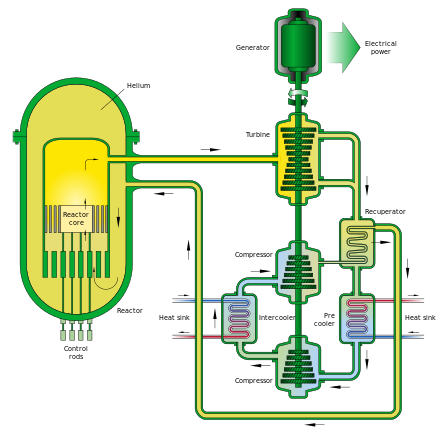 Gas Cooled Fast Reactor Prototype
Sourced from Generation IV International Forum
GSFR is a type of fast neutron reactor, a special subset of nuclear reactors which transform spent nuclear fuel into usable fissile material in something called a “closed fuel cycle”, and in doing so they produce very little waste. The neutrons shot at fissile atoms to begin the fission reaction in fast reactors are much higher in energy than traditional thermal reactors, which allows metals heavier than Uranium such as Curium to be used as fuel (in traditional nuclear reactors, metals such as Curium are discarded as nuclear waste). This higher neutron energy means that GSFR will operate under higher temperatures (850°C as opposed to ≈300°C) than Gen-3 reactors and has a closed fuel cycle in which used spent uranium is reprocessed and usable plutonium and uranium are extracted. This means that nearly 30% of the original uranium’s energy can be regained and this reduces the quantity of radioactive waste by 80%. The reactor uses Helium as its coolant and produces electricity in two ways: 1) Heat-exchanger transfers heated helium to a helium-nitrogen mixture that turns a closed cycle gas turbine 2) Excess “waste” thermal energy from a gas turbine heats water, produces steam, and turns a traditional steam generator (“Gas-Cooled Fast Reactor”). The two main advantages of GSFR are long term Uranium sustainability / waste minimalism due to fuel reprocessing and high thermal efficiency, meaning that at higher temperatures heat energy converts to electricity at more efficient rates. The temperatures in a GSFR are so great in fact that other industrial byproducts can be produced, most prominently commercial hydrogen. Currently, commercial hydrogen is produced using a process called Steam Methane Reforming (SMR) which separates hydrogen atoms from methane, and emits gaseous carbon monoxide and CO2 into the atmosphere (“Production of hydrogen – U.S. EIA”). Within the high temperature environment of a GSFR, commercial hydrogen can be produced using methane pyrolysis which is much more environmentally sustainable than current methods for hydrogen production as byproduct CO2 is produced in solid form making it easily capturable and even usable in products such as carbon fiber (Rapier).
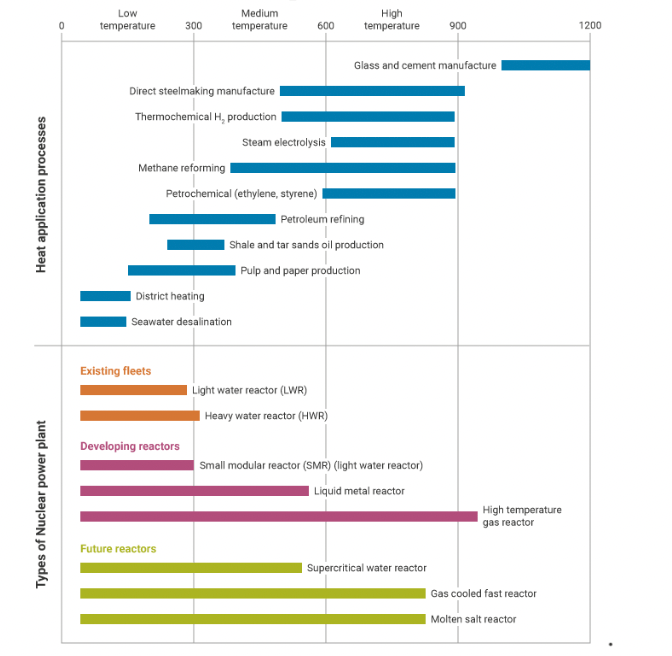 A Comparison of heat application processes to the temperature level within different types of nuclear power plants. As shown, hotter reactor types including Molten Salt Reactors and Gas Cooled Fast Reactors have many more industrial applications, such as H2 production, than existing reactors.
Sourced from The World Nuclear Association
Conclusion
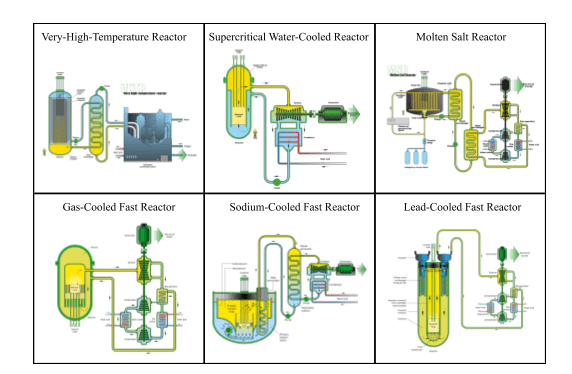 The 6 Gen-4 International Forum Supported Designs
Individual Images sourced from Generation IV International Forum, Compiled by AJ Caesar
In conclusion, these two designs make up just a third of the six designs endorsed by the international forum (pictured above), all of which address cost, safety, and sustainability goals in unique manners. Half of the designs involve fast reactors, which, as stated above, hope to reuse uranium fuel for multiple iterations thereby maximizing long term viability. One interesting point to note is that only two of the six designs use water as their coolant, meaning that the majority of such designs could be placed at inland locations – potentially increasing the range and safety of nuclear energy by mitigating concerns of floods or tsunamis. However, these designs face challenges such as the cost of implementation and proof of concept. Overall, it will be intriguing to see how these designs come to fruition in the coming decade, though their development also hinges on political and societal approval of nuclear energy (nuclear development in Japan and Germany has backtracked in recent decades, and in the US it is essentially at a standstill).
About the Author
AJ Caesar is a high school senior passionate about spreading digestible scientific knowledge to global youth. He is interested in renewable energy, particularly the capabilities of nuclear energy, and therefore hopes that his work will better inform the public on the development of next generation nuclear reactors.
Works Cited
“Fukushima Daiichi Accident.” World Nuclear Association, https://world-nuclear.org/information-library/safety-and-security/safety-of-plants/fukushima-daiichi-accident.aspx. Accessed 13 August 2022.
“Fukushima disaster: What happened at the nuclear plant?” BBC, 10 March 2021, https://www.bbc.com/news/world-asia-56252695. Accessed 14 August 2022.
“Generation IV International Forum.” GIF Portal – Portal Site Public Home, https://www.gen-4.org/gif/. Accessed 13 August 2022.
“Gas-Cooled Fast Reactor (GFR).” Generation IV International Forum (GIF), https://www.gen-4.org/gif/jcms/c_42148/gas-cooled-fast-reactor-gfr. Accessed 14 August 2022.
Harman, Sarah. “NUCLEAR 101: How Does a Nuclear Reactor Work?” Department of Energy, 29 March 2021, https://www.energy.gov/ne/articles/nuclear-101-how-does-nuclear-reactor-work. Accessed 13 August 2022.
“History | Molten Salt Reactor | ORNL.” Oak Ridge National Laboratory, https://www.ornl.gov/molten-salt-reactor/history. Accessed 13 August 2022.
Howard, Don. “The Moral Imperative Of Green Nuclear Energy Production.” Journal on Emerging Technologies, https://ndlsjet.com/wp-content/uploads/2020/01/The-Moral-Imperative-of-Green-Nuclear-Energy-Production.pdf. Accessed 13 August 2022.
Millikin, Mike. “Los Alamos Lab to lead $9.25M project to model materials behavior in molten salt reactors.” Green Car Congress, 13 August 2022, https://www.greencarcongress.com/2022/08/20220813-lanl.html. Accessed 13 August 2022.
“Nuclear Process Heat for Industry.” World Nuclear Association, https://world-nuclear.org/information-library/non-power-nuclear-applications/industry/nuclear-process-heat-for-industry.aspx. Accessed 14 August 2022.
Nunez, Christina, et al. “Micro-nuclear reactors: up to 20MW, portable, safer.” Energy Post, 22 April 2021, https://energypost.eu/micro-nuclear-reactors-up-to-20mw-portable-safer/. Accessed 14 August 2022.
Patel, Sonal. “TVA, Kairos Partner to Deploy Molten Salt Nuclear Reactor Demonstration.” POWER Magazine, 6 May 2021, https://www.powermag.com/tva-kairos-partner-to-deploy-molten-salt-nuclear-reactor-demonstration/. Accessed 13 August 2022.
“Plans for New Nuclear Reactors Worldwide.” World Nuclear Association, https://world-nuclear.org/information-library/current-and-future-generation/plans-for-new-reactors-worldwide.aspx. Accessed 14 August 2022.
“Processing of Used Nuclear Fuel.” World Nuclear Association, https://world-nuclear.org/information-library/nuclear-fuel-cycle/fuel-recycling/processing-of-used-nuclear-fuel.aspx. Accessed 14 August 2022.
“Production of hydrogen – U.S. Energy Information Administration.” EIA, 21 January 2022, https://www.eia.gov/energyexplained/hydrogen/production-of-hydrogen.php. Accessed 14 August 2022.
Rapier, Robert. “Nuclear Reactors Could Provide Plentiful Zero-Carbon Hydrogen, If Only We Let Them.” Forbes, 29 April 2021, https://www.forbes.com/sites/rrapier/2021/04/29/clean-hydrogen-from-nuclear-power/?sh=704cda7e55f6. Accessed 14 August 2022.
Touran, Nick. “Benefits of Molten Salt Reactors.” Learn about nuclear energy, https://whatisnuclear.com/msr.html. Accessed 13 August 2022.
“U.S. nuclear industry – U.S. Energy Information Administration.” EIA, 18 April 2022, https://www.eia.gov/energyexplained/nuclear/us-nuclear-industry.php. Accessed 14 August 2022.