
Key Vocabulary:
Apoptosis: programmed cell death
Cyanobacteria: photosynthetic, prokaryotic, and aquatic bacteria, often identified with blue or green colors
Eutrophication: when a body of water becomes rich in materials such as nitrogen and phosphorus, often caused by runoff from land or rivers.
Hepatitis: inflammation of the liver
Hepatocyte: liver cell
Intro
We owe a lot to Cyanobacteria. These prokaryotic (single-celled) and photosynthetic organisms were the first organisms on Earth to perform photosynthesis three billion years ago, transforming a Methane and Carbon-Dioxide dense atmosphere into the Nitrogen and Oxygen rich one that supports our species today (Aiyer, 2022). This event, termed the “Great Oxygenation” paved the way for the survival of multicellular aerobic organisms. After billions of years and multiple mass extinctions, cyanobacteria still thrive in aquatic environments, and while they are a necessary part of the ecosystem at natural quantities, when they come to rapidly multiply in a process called Cyanobacterial blooms they can poison drinking water, outcompete aquatic plants and animals, and cost millions of dollars to mitigate each year.
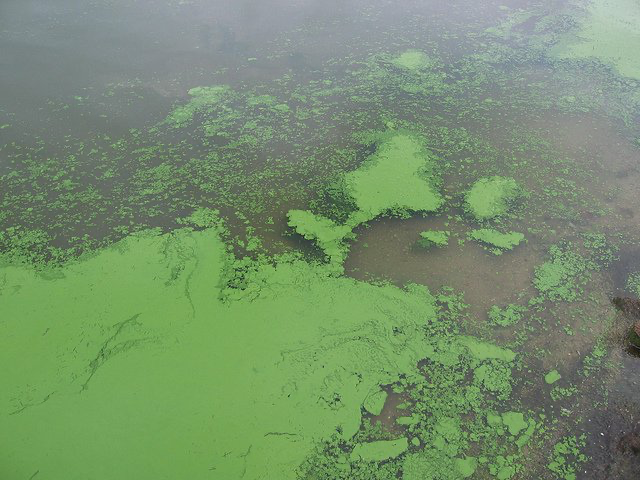 Cyanobacterial bloom in Lake Binder, Iowa. Photo: Dr. Jennifer Graham, USGS
Sourced from epa.gov
What is a cyanobacterial bloom?
Cyanobacterial blooms occur when the conditions necessary for high rates of bacterial survival and division become present in vast quantities. This includes warm, still-moving water bodies with a high presence of phosphorus, nitrogen, and other elements that can often be the aftermath of agricultural runoff or dumping of human waste (a process called eutrophication). When such conditions are met, Cyanobacteria rapidly reproduce and form masses like the one shown above. According to research out of MIT and the University of California at San Diego, the reproduction cycle of Cyanobacteria follows a circadian (24 hour) rhythm similar to that which governs human sleep, meaning that Cyanobacteria can double in quantity within a 24 hour period (Trafton, 2010). They form large masses rich with green aoras, and have therefore earned the nickname “blue-green algae” even though this distinction is technically incorrect as “algae” is now a term reserved for eukaryotic organisms in the scientific realm (Algae & Cyanobacteria – GreenWater Laboratories, n.d.).
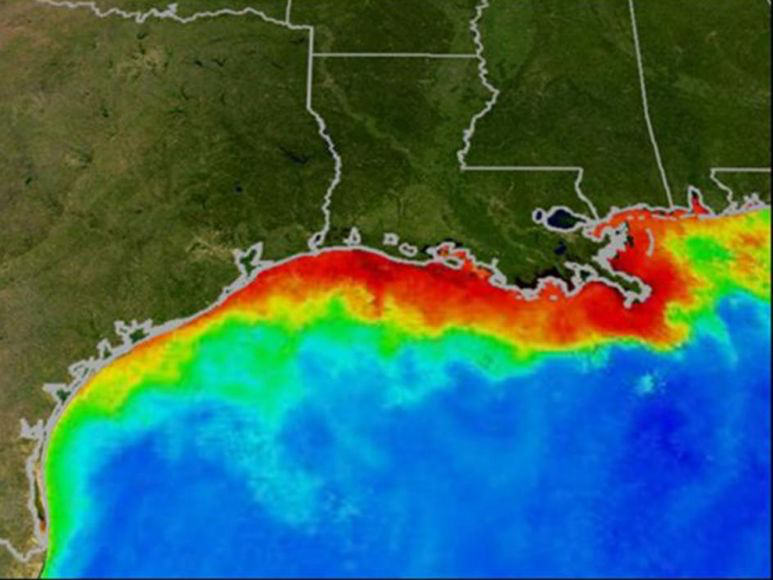 Gulf Dead Zone where almost no life exists during the Summer, and which many scientists attribute to eutrophication of the water from agricultural runoff out of the Mississippi Basin.
Sourced from National Geographic
The Dangers of Cyanobacterial Blooms
Dead-Zones – Hypoxia, Out Competition
As organic compounds such as phosphorus enter large bodies of water, Cyanobacterial blooms arise. When Cyanobacterial blooms occur, the bacteria do not just multiply, but also die in masses. This causes a process known as Hypoxia.
When any organism decomposes, it follows the chemical equation:
CH20 (organic matter) + O2 → H20 + CO2 + Nutrients
As seen, Oxygen is a reactant in the equation for decomposition, and Carbon Dioxide is a product. This means that when decomposition of Cyanobacteria occurs in water, Oxygen is taken out of the water and Carbon Dioxide is added. Dissolved carbon dioxide in water turns into Carbonic Acid (H2CO3), which, when combined with the removal of oxygen, greatly increases the acidity, or decreases the pH, of water. In more latent terms, there is less oxygen available in the water for organisms that need it to survive. This creates large inhabitable expanses, called Dead Zones. When runoff from the Mississippi Basin, the agricultural heart of the United States, enters into the Gulf of Mexico each year, this process occurs and a 20,000 square kilometer inhabitable area forms (Dead Zone, 2022).
In addition to reducing the oxygen content in water, Cyanobacteria also detriment aquatic ecosystems by outcompeting other photosynthetic life which ripples through the food chain. When Cyanobacteria form their masses at the surface, they prevent sunlight from reaching beneath the surface and other plant life cannot survive. This furthers their deadly impact.
Cyanotoxins
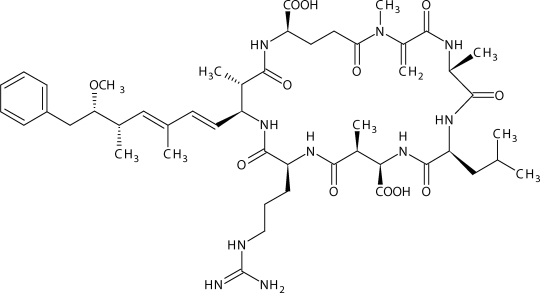 Chemical structure of Microcystin, an inhibitor of protein phosphatase
Sourced from Office of Environmental Health Hazard Assessment California Environmental Protection
In the summer of 2019, the state government of New Jersey faced backlash from residents when the state’s largest lake, Lake Hopatcong, was shut down after unsafe quantities of Cyanobacteria were found to have inhabited the lake (New Jersey Issues…, 2020). The government’s defense cited Cyanotoxins, which have the power to cause rashes if they come into contact with skin, or even kill if ingested. Cyanotoxins form naturally within a Cyanobacterial cell, and the most widely occurring are Microcystines, shown below (Bláha et al., 2009). In simple terms, they are liver toxins. The chemical structure of Microcystins makes them inhibitors of protein phosphatase enzymes: causing apoptosis of Hepatocytes, Hepatitis, and even liver failure (Butler et al., 2009). Therefore, Cyanotoxins not only threaten fish and freshwater crustaceans, but also humans and cattle that directly rely on infested bodies of water for drinking water.
Prevention
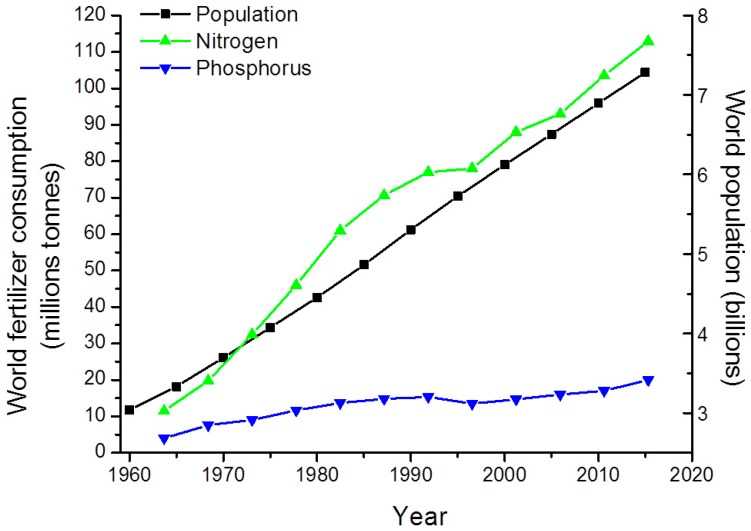 Graph of world fertilizer consumption in comparison with human population, per United Nations data. This demonstrates that the quantity of fertilizer will only continue to grow, increasing eutrophication of waterways and the Cyanobacterial problem.
Figure adapted from FAO & United Nations data by Timothy Otten.
Chemical Controls
Chemical controls are a cheap and effective way to kill cyanobacteria, though it is hard to stop them from killing off entire aquatic ecosystems as well. According to the EPA, commercially produced chemicals to counter cyanobacteria are called Cyanobacteriacides, and they usually consist of a copper-based solution, such as copper sulfate, that binds to the cyanobacterial cells and destroys their cellular membrane, eventually killing them (Control Measures for Cyanobacterial HABs in Surface Water | US EPA, 2022). However, these toxic algaecides can also kill zooplankton and other invertebrates, harming ecosystems. Some farmers have turned to more natural remedies, as studies have found that the chemicals in barley straw can react with Cyanobacteria and inhibit the growth of blooms. While these methods are cheap, they often sacrifice either efficiency or safety.
Physical Controls
When you see a fountain in the center of a pond, what do you think it’s purpose is? Aesthetics? In fact, these fountains are an example of a physical control for Cyanobacteria, as their constant movement of surface water disrupts the multiplication process of Cyanobacteria and helps keep ponds clean. However, these methods cannot be practically transferred to lakes and seas, so instead experts have looked at new methods to combat blooms across vast bodies of water. LG has recently created an ultrasonic device that has proved both effective at killing Cyanobacteria and at preserving other aquatic species (How LG Sonic Ultrasound Technology Controls Algae, n.d.). In Lake Okeechobee, innovative robots skim Cyanobacteria from the surface and collect them for creation of renewable biofuels (Group Looks to Clean Algae With New Technology, 2018). New innovative products are created every year, and it will be exciting to see what the future of Cyanobacterial mitigation beholds.
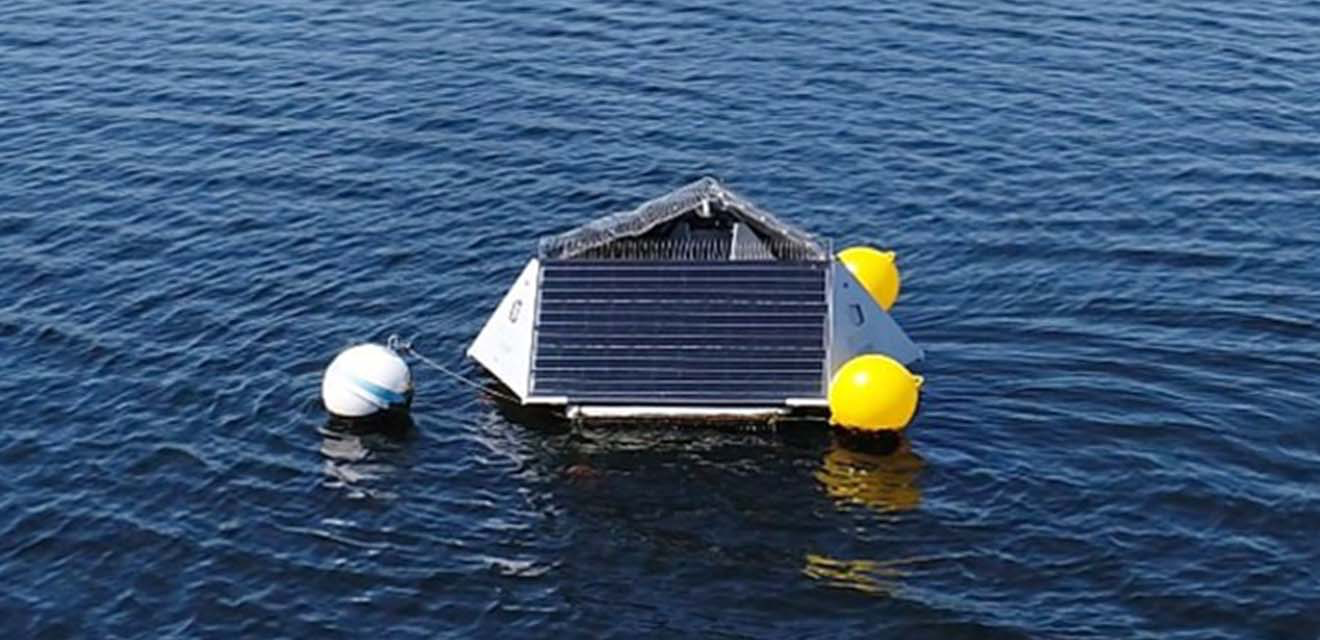 LG ultrasound cyanobacteria inhibitor
Courtesy of LG Sonic
Reform Your Actions
In regards to a call to action, scientists have agreed on a multiple step protocol that citizens can undertake to reduce the chances of their causing a cyanobacterial bloom in both their local area and far away water bodies. Primarily, citizens should reduce their usage of fertilizers to prevent water eutrophication. Plucking backyard weeds by hand and buying responsibly sourced produce are two methods by which citizens can prevent unnatural quantities of phosphorus and nitrogen from penetrating water bodies and giving cyanobacteria the nutrients necessary for population explosion. Additionally, citizens can allow natural vegetation, as opposed to grass or concrete, to border bodies of water as such vegetation aptly absorbs said nutrients. Finally, if any concern arises regarding a bloom, water management experts should be contacted and the water promptly tested (Protect Yourself and Your Pets | Harmful Algal Blooms, n.d.).
References
(2020, August 17). New Jersey issues warnings for two more toxic algae blooms in Lake Hopatacong. Retrieved July 6, 2022, from https://www.northjersey.com/story/news/2020/08/17/lake-hopatcong-nj-issues-warnings-two-more-toxic-algae-blooms/3380362001/
Aiyer, K. (2022, February 18). The Great Oxidation Event: How Cyanobacteria Changed Life. American Society for Microbiology. Retrieved July 6, 2022, from https://asm.org/Articles/2022/February/The-Great-Oxidation-Event-How-Cyanobacteria-Change
Algae & Cyanobacteria – GreenWater Laboratories. (n.d.). GreenWater Laboratories. Retrieved July 6, 2022, from https://www.greenwaterlab.com/algae-cyanobacteria/
Bláha, L., Babica, P., & Maršálek, B. (2009, June). Toxins produced in cyanobacterial water blooms – toxicity and risks. National Library of Medicine. Retrieved July 6, 2022, from https://www.ncbi.nlm.nih.gov/pmc/articles/PMC2984099/
Butler, N., Carlisle, J. C., Linville, R., & Washburn, B. (2009, March). Microcystins: A brief overview of their toxicity and effects, with special reference to fish, wildlife, and livestock. OEHHA Ecotoxicology.
Control Measures for Cyanobacterial HABs in Surface Water | US EPA. (2022, April 26). US Environmental Protection Agency. Retrieved July 6, 2022, from https://www.epa.gov/cyanohabs/control-measures-cyanobacterial-habs-surface-water
dead zone. (2022, May 19). National Geographic Society. Retrieved July 6, 2022, from https://education.nationalgeographic.org/resource/dead-zone
Group looks to clean algae with new technology. (2018, August 1). Fox 4 News. Retrieved July 30, 2022, from https://www.fox4now.com/news/local-news/florida-non-profit-looks-to-clean-up-algae-with-new-technology
How LG Sonic Ultrasound Technology Controls Algae. (n.d.). LG Sonic. Retrieved July 30, 2022, from https://www.lgsonic.com/how-lgsonic-ultrasound-technology-controls-algae/
NCEH Cyanobacteria Blooms Fact Sheet. (n.d.). Centers for Disease Control and Prevention. Retrieved July 6, 2022, from https://www.cdc.gov/habs/pdf/cyanobacteria_faq.pdf
Protect Yourself and Your Pets | Harmful Algal Blooms. (n.d.). CDC. Retrieved July 31, 2022, from https://www.cdc.gov/habs/prevention-control.html
Trafton, A. (2010, April 8). Bacteria divide like clockwork: Cell division in cyanobacteria controlled by same kind of circadian rhythms that govern human sleep. ScienceDaily. Retrieved July 6, 2022, from https://www.sciencedaily.com/releases/2010/03/100318141544.htm
About the Author
AJ Caesar is a high school student with dreams of one day tackling pertinent climate issues as an engineer. He hopes that those who read his articles will be inspired to reform their habits and properly informed on how to do so in order to protect their local environment. Please reach out with any comments, questions, and concerns at iysj.ajcaesar@gmail.com.