
Important Vocabulary
Antimatter (noun): positron, antiproton, antineutron; particles equal in size and opposite in charge of the standard three subatomic particles, which form energy in the form of photons when collided with electrons, protons, and neutrons respectively
Chemical Energy (noun): energy stored within the bonds of atoms and molecules, can be released as thermal energy when the object is ignited
Mass Defect (noun): difference between the actual atomic mass of an atom and the predicted mass calculated by summing the mass of protons and neutrons in the nucleus.
Petroleum (noun): a liquid mixture of hydrocarbons that can be extracted and used as a fossil fuel; crude oil
Photon (noun): light particle, massless form of energy
1.0 Introduction
Energy equals mass times the speed of light squared. Einstein’s 1905 equation ties together three of our universe’s most fundamental concepts – mass, energy, and the constant speed of light – in such a way that redefines modern physics. His discovery presents mass and energy as different forms of the same fundamental thing, contradicting previous thought that mass and energy were two entirely different entities. Such a momentous discovery eventually became the basis of nuclear physics and nuclear engineering, fields of innovation that have created both weapons of mass destruction and some of the cleanest energy available today. So how did this equation come about, what does it mean on a scientific level, and what implications does it have for our ever-growing world?
2.0 History
Prior to the 20th century, the generally accepted notion in science was that mass and energy were two fundamentally different concepts. Therefore, the Law of The Conservation of Mass and Law of Conservation of Energy lived independently from one another in scientific experiments and journals. Then, in the late 1800s physics took a turn away from classical Newtonian physics and began investigating the phenomena of light, electricity, and magnetism. Scientists began seeing small contradictions in their new discoveries that Newtonian physics could not explain, and while most disregarded them, Einstein arose as one to confront these complexities. It took him ten years of thought experiments, but eventually, once he came to accept that the speed of light is a universal constant – meaning it is equal no matter the speed or position of the observer – he was able to publish astounding breakthroughs. This led to Einstein’s annus mirabilis: 1905, his “miracle year”. In this year, working in a Swiss patent office he published four of his most famous and transformational papers. The first dealt with the photoelectric effect and stated that light energy is composed of measurable “quanta”, now called photons, moving in waves. His second centered around Brownian motion, explaining why suspended particles move randomly. His third introduced the theory of Special Relativity, and his fourth, a build on of his first and third, put forth the theory of mass energy equivalence (Renn & Hoffman, 2005). That E=mc2. A mathematical proof of this equation can be found here, though in essence it stems from his ideas regarding special relativity and the constant speed of light. He realized that when an object emits light (energy), it loses mass, and the amount of which is equal to E/c2 (Quantity of energy emitted divided by the constant speed of light squared) (Rothman, 2015). When rearranging this observation we see that E = mc2. Immediately, his papers were met with backlash from critics that feared he would destroy the merits of Newtonian physics. In fact, Einstein’s theories did overrule some Newtonian principles including that gravity is instantaneous. However, Einstein’s thinking that at the time was regarded as radically incorrect has now become standard for physicists across the globe and led to new innovative fields such as quantum mechanics and nuclear science, demonstrating the benefit that comes from the introduction of contemporary thought into traditional physics.
2.1 Proof
If mass is a form of energy, then energy must also be able to transform to mass. In 1934 Gregory Breit and John Wheeler hypothesized that by smashing two photons together an electron and positron (small positively charged subatomic particle) could be created. Then, in recent years this was proved by scientists at Brookhaven National Laboratory who accelerated gold ions to 99.999% the speed of light and created electrons (mass) from surrounding photons (massless). This further proved the concepts implied by Einstein’s equation that energy can transform to mass and vice versa under very specific conditions.
2.2 The Manhattan Project
Another proof of Einstein’s theories came in a less fortunate form: the bombings of Hiroshima and Nagasaki, and the ensuing nuclear arms race that plagues our planet to this day. In Little Boy, the bomb dropped on Hiroshima, there existed just 64 Kg of Uranium,yet the explosive force was equal to 15 kilatons of TNT. This was a major demonstration to the world of the mind blowing capabilities of nuclear fission. Then, in the decades after Hiroshima and Nagasaki, the Russian government demonstrated the even greater capabilities of nuclear fusion – the energy released when hydrogen isotopes combine to create helium – when showcasing their hydrogen bomb. Luckily, in recent years focus has shifted from using nuclear bombs to flatten homes to instead power them, which will be discussed in section 5.
3.0 Scientific Explanation
I want to open up this scientific explanation of E = mc2 with a bit of a shocker. When you learned about The Law of Conservation of Matter – that matter cannot be created or destroyed – you may have learned something that was technically incorrect. Atleast, you may not have been presented with the entire truth. For example, let’s take the indisputable observation that the reactants in a nuclear fission reaction are slightly more massive than the products (Jha, 2014). The difference is extremely minimal and exceptionally precise measuring equipment is needed to detect it. However, it exists, and it contradicts the idea that matter cannot be destroyed. In order to correct the imbalance, we must use Einstein’s equation and quantify the energy released in the reaction. When converted to mass using E = mc2 we will see that it equals this critical difference. Therefore, the more correct way to define conservation of matter would be that the sum of energy and mass is conserved. Since Einstein tells us that these two concepts are essentially the same thing, they can all be grouped into the Conservation of Energy. Now let’s look in depth into how this works.
3.1 Mass Defect
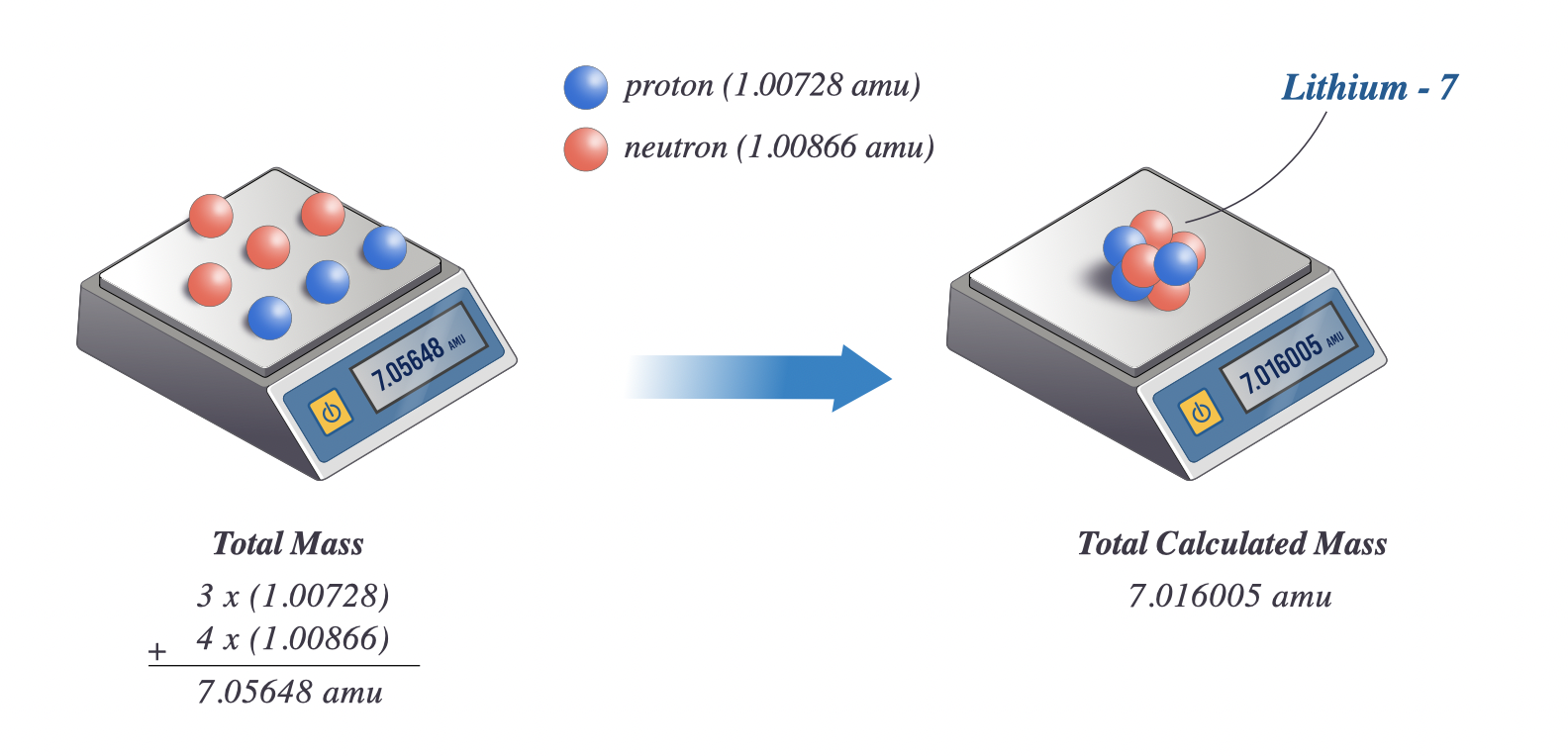 Demonstration of Mass Defect in Lithium – 7
Courtesy of LibreTexts
Mass defect is the understanding that the mass of a nucleus is less than the mass of the sum of the nucleons (Protons and neutrons) if they were free. Let us consider the Lithium-7 isotope pictured below. We see that the total mass of the nucleus is lighter than the sum of its parts. This seems to disregard the Law of Conservation of Mass. In fact, it plainly does. So where did the 0.040475 (7.05648 – 7.016005) amu go? Energy. Using the mass energy equivalence and conservation of energy we can determine that this difference has been transformed into energy stored within the nucleus, energy that can then be harnessed by breaking that atom back apart in a fission reaction.
3.2 Strong Force
You may still be wondering, where does the energy in a nuclear reaction actually come from? Well, it takes a massive amount of energy to bind together positively charged protons within the nucleus of an atom. It is as if you held together the positive poles of two bar magnets – it would take a massive force to overcome their repellant nature. This force within the atomic nucleus is called the strong force, and it is what allows protons and neutrons to bind into an extremely compacted cluster. However, this bond is not unbreakable, and it breaks during a nuclear reaction. When this force is broken in a nuclear reaction, it causes the release of the massive quantities of energy that Einstein’s equation suggests.
3.3 Annihilation and Antimatter
One of the hardest concepts to grasp regarding Einstein’s equation is that matter can in fact be destroyed. Atleast, transferred from subatomic particles that have mass to light particles (photons) that do not. To understand this concept, we must explore the concept of antimatter. Antimatter is the idea first hypothesized by Paul Dirac in the 1920s that particles of matter have equal and opposite particles of antimatter that they can combine with to form massless energy. Proton (positively charged): Antiproton (negatively charged). Electron (negatively charged): Positron (positively charged). Neutron (neutrally charged): Antineutron (neutrally charged). Each particle of matter and its counterpart of antimatter have equal mass. According to current scientific thought, in the early stages of the Big Bang only energy existed. Then, photons divided into matter and antimatter and created mass according to Einstein’s equation (Mann, 2021). In current times, antimatter is extremely rare in our universe while matter is abundant. Scientists are not really sure why, though multiple theories exist including that matter and antimatter were never created in a 1 to 1 ratio. Overall, we can think of antimatter and matter as positive and negative numbers. If you combine -1 and 1, then they cancel, or annihilate each other, to get zero (nothing). In the same way, if you combine a particle of matter with its equal particle of antimatter, you have a process called annihilation in which they combine to form massless energy (of a quantity determined by E = mc2). This is the process by which matter can technically be destroyed (or annihilated) and transform into energy.
4.0 Implications
According to Einstein’s equation, the energy contained within the mass of a penny (2.5g) is equal to about 225,231,211 Megajoules. In perspective, NYC uses about 11,500 MegaWatts of power in the summer months (Energy – Sustainability, n.d.). 1 Watt = 1 Joule per second, and 1 Megawatt = 1 Megajoules per second. So, according to Einstein’s equation, the energy contained within the mass of a medium-sized adult could power all of New York City for 19,585 (225,231,211 / 11,500) seconds, or about 5 hours and 26 minutes. Not bad, eh? If mass can produce so much energy, why don’t we just start harnessing energy from plastic, dirt, and all the other “stuff” that surrounds us rather than worry about the impending energy crisis constantly discussed by scientists. Unfortunately, this is a quixotic dream. In reality, while energy does exist in all mass, humans are unable to harness it in 99%+ of cases.
4.1 Inaccessible Energy Reserves
As scientists frantically struggle to fulfill the expanding energy needs of a growing human population, Einstein’s equation seems to tell us that the solution is all around us. Matter. However, much of these energy reserves are inaccessible to us because of our limited technology. The best metaphor I can use to explain this phenomenon is to compare our current situation to that of a person with massive petroleum reserves sitting right in front of them yet unable to create or harness fire. The energy is still there, trapped within oil’s hydrocarbon bonds, but without fire there is no way that it can be converted from chemical potential energy to a usable form of heat energy. Therefore, the person has to accept that they have millions of joules of energy before their eyes with no practical way to harness them in a useful form. In our current situation, we know – at least Einstein’s equation tells us – that the energy within a penny could support NYC for hours, but with our current technology that energy remains potential – trapped between the particles that make up all mass at a subatomic level.
4.2 Energy of various flavors
When considering the two thought experiments poised above, it is important to remember the different types of energy present within our universe. And I am not talking about forms of energy – light energy, heat energy, mechanical energy, gravitational energy, electrical energy, sound energy, chemical energy, nuclear energy, etc. – but instead kinetic vs potential energy. At its heart, energy is the ability to do work. An engineless car rolling at 60 miles per hour in a frictionless world has the ability to travel 60 miles in 1 hour. However, a car at rest with a combustible engine and full tank of gasoline also has the ability to travel 60 miles in 1 hour. Both of these cars have energy – the ability to travel 60 miles in 1 hour – though the form of energy is different in each. For the first, the energy is kinetic: it is within the motion of the car. For the second, the energy is potential: it is within the hydrocarbon bonds of the gasoline in the car’s tank. However, with only a full tank of fuel and no combustible engine, the second car does not have the ability to do work despite potential energy still being present. As humans we desire a transfer of nuclear energy from potential to electrical energy which can then be used as kinetic energy powering electric cars and more, but this requires the assistance of advanced technology and very specific circumstances. Einstein tells us that all mass has energy, but being that the majority is potential energy stored within the strong force of atomic nuclei and we have no method for its conversion, it is essentially unusable for human desires.
4.3 Our Limited Nuclear Capabilities
When I discuss the lack of technology that renders humans incapable of accessing energy from the majority of mass around us, I allude to the fact that in most cases unfathomably high temperatures are needed to do so. An incredible amount of energy is needed to fuse or fiss two nuclei whose shared positive charges vigorously repel. Our sun can perform fusion due to its high temperature, something nearly unreplicatable on Earth. However, some opportunities for the application of nuclear energy are available. We can use Uranium-235, for example, because it is the largest naturally occurring (and therefore most unstable) atom.
5.0 Significance for Nuclear Energy
Despite humans being unable to access the nuclear energy present within most objects, in the few cases we can, vast quantities of energy are produced with few drawbacks. When we think about the massive scale of Einstein’s equation, it it no wonder that the nuclear reaction involving one Uranium pellet (roughly the size of a thimble) can produce as much energy as the chemical energy released by the burning of 150 gallons of oil or 1 ton of coal (Nuclear Fuel, n.d.). Uranium is used because its atoms split apart relatively easily. It is the largest naturally occurring atom, and its large size makes it vulnerable to fission. However, as nuclear technology progresses it is vital that scientists find ways to perform fission with smaller and smaller atoms while also continuing to explore the possibilities of fusion. To learn more about nuclear energy, read my other article linked here.
References
(2013, October 21). Why is mass conserved in chemical reactions? | Science Questions with Surprising Answers. Retrieved February 11, 2022, from https://www.wtamu.edu/~cbaird/sq/2013/10/21/why-is-mass-conserved-in-chemical-reactions/
Energetics of Nuclear Reactions. (2020, September 22). Chemistry LibreTexts. Retrieved February 2, 2022, from https://chem.libretexts.org/Bookshelves/Physical_and_Theoretical_Chemistry_Textbook_Maps/Supplemental_Modules_(Physical_and_Theoretical_Chemistry)/Nuclear_Chemistry/Nuclear_Energetics_and_Stability/Energetics_of_Nuclear_Reactions
Energy – Sustainability. (n.d.). NYC.gov. Retrieved February 1, 2022, from https://www1.nyc.gov/site/sustainability/our-programs/energy.page
The Equivalence of Mass and Energy (Stanford Encyclopedia of Philosophy). (2001, September 12). Stanford Encyclopedia of Philosophy. Retrieved February 1, 2022, from https://plato.stanford.edu/entries/equivME/
Ferreira, B. (2021, September 20). Government Scientists Are Creating Matter From Pure Light. VICE. Retrieved February 2, 2022, from https://www.vice.com/en/article/wx53vx/government-scientists-are-creating-matter-from-pure-light
Focus on Physics: How E = mc2 Helps Us Understand Nuclear Fission and Fusion. (2016, December 21). NSTA. Retrieved February 2, 2022, from https://www.nsta.org/blog/focus-physics-how-e-mc2-helps-us-understand-nuclear-fission-and-fusion
Jha, A. (2014, April 5). E=mc2: Einstein’s equation that gave birth to the atom bomb. The Guardian. Retrieved February 12, 2022, from https://www.theguardian.com/science/2014/apr/05/einstein-equation-emc2-special-relativity-alok-jha
Mann, A. (2021, December 13). What is Antimatter? Live Science. Retrieved February 14, 2022, from https://www.livescience.com/32387-what-is-antimatter.html
Nuclear Fuel. (n.d.). Nuclear Energy Institute. Retrieved February 2, 2022, from https://www.nei.org/fundamentals/nuclear-fuel
Renn, J., & Hoffman, D. (2005, April). 1905 A Miraculous Year. Journal of Physics B: Atomic, Molecular, and Optical Physics, 38(9), S437 — S448. https://doi.org/10.1088/0953-4075/38/9/001
Rothman, T. (2015, August 24). Was Einstein the First to Invent E = mc2? Scientific American. Retrieved February 2, 2022, from https://www.scientificamerican.com/article/was-einstein-the-first-to-invent-e-mc2/
Section B: Two Main Forms of Energy – Energy Education: Concepts and Practices | UWSP. (n.d.). UW-Stevens Point. Retrieved February 3, 2022, from https://www3.uwsp.edu/cnr-ap/KEEP/nres633/Pages/Unit1/Section-B-Two-Main-Forms-of-Energy.aspx
About the Author
AJ Caesar is a highschool senior from New Jersey. He is a strong believer that expanding nuclear energy could be one of the best solutions to the impending green energy crisis. Therefore, he wants to inform others on its principles and capabilities, which start with Einstein’s equation. Please reach out to iysj.ajcaesar@gmail.com with any questions.