
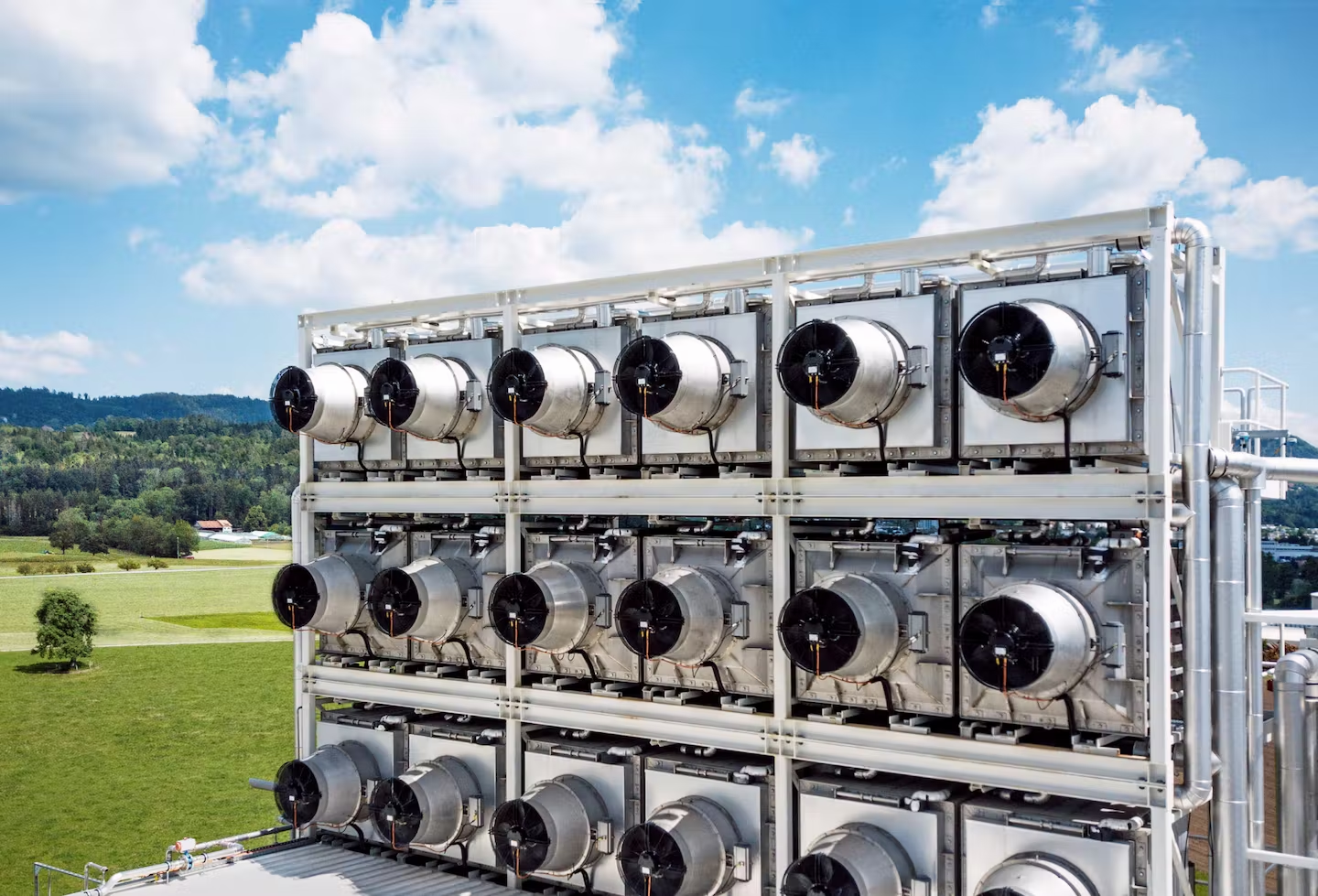
 Capricorn DAC Plant in Hinwil, Switzerland
Sourced from Climeworks
On August 16, 2022, President Joe Biden signed the historic Inflation Reduction Act of 2022 into law, constituting the most significant action in history that the United States has taken to mitigate climate change. The Inflation Reduction Act works to decarbonize the economy at all levels, including consumer incentives to purchase energy efficient homes and vehicles, tax credits for manufacturers to transition to environmentally friendly products or business practices, and green investments into agriculture and marginalized communities (“Summary”). Specifically, the Advanced Industrial Facilities Deployment Program within the Inflation Reduction Act sets aside $5.8 billion for advanced industrial technologies such as Carbon Capture and Storage (CCS). The government subsidy per metric ton of carbon dioxide (CO2) captured will increase 70%, from $50 to $85, a monumental shift expected to increase focus on CCS (De La Garza).
So what is CCS?
Modern Carbon Capture and Storage technology, in simple terms, removes CO2 from the atmosphere and stores it underground for long periods of time with the goal of reducing global warming. Also known as carbon dioxide removal (CDR), the geoengineering process employs negative emissions technology, which has become an increasingly prevalent factor in national mitigation strategies, as seen in the United States (Shepherd).
There are a variety of CCS methods currently in operation at power plants and industrial facilities: oxy-combustion systems burn fuel in a pure-oxygen environment to concentrate CO2 for collection, pre-combustion carbon capture separates CO2 from fossil fuels during the combustion process, while post-combustion carbon capture separates CO2 from other harmful gasses from the air for it to be stored (Gonzales). Oxy-combustion and pre-combustion systems may be implemented within new power plants and industrial facilities, while post-combustion carbon capture is easiest to implement near older power plants. The first large-scale project of this nature was implemented in 1972 on an oilfield in Sharon Ridge, Texas, and currently captures 1.3 megatons of CO2 per year via pre-combustion technology (“Carbon Capture and Sequestration”). Over 20 million tons of CO2 are captured and stored in the United States annually (Varanasi); for comparison, the average American produces about 7.5 tons per year, so CCS can mitigate the emissions of over 2.5 million Americans (“Average US Household”).
More recently, Direct Air Capture (DAC) has emerged as a new CSS method. The first industrial-scale DAC plant, called Capricorn, opened in 2017 in Hinwil, Switzerland by Climeworks, an organization which now has fifteen total machines in operation worldwide (“Achieve net zero”). DAC captures CO2 directly from the air using large fans, which passes through a series of filters that segregates the CO2 particles for heating and storage.
Once the CO2 is captured from the air, whether captured at a power plant source or with DAC technology, it needs to be transported and stored hundreds of meters underground. The most common storage location is within oil and natural gas reservoirs, which is widely used and is currently the only profitable method of carbon storage (Roberts). Known as enhanced oil recovery (EOR), high-pressure CO2 is driven into reservoirs to bond with and push oil to the surface, and can recover up to sixty percent of oil in a given location. A myriad of substances, including nitrogen and natural gas, can be used to extract oil, though use of CO2 allows corporations to benefit from subsidies whilst accomplishing the same goal (“Carbon Storage FAQs”). Another common underground storage location is saline formations, which have the largest potential volume for storing CO2 and can be found across Canada and the United States. Alternatively, Climeworks focuses on building its plants on top of basalt formations, which are formed from lava flows. Basalt is rich in magnesium and calcium, which CO2 reacts with to form calcite and dolomite; this permanently traps CO2 in a solid mineral structure, and is found to capture over 90% of injected CO2 (Cartier).
Why is CCS necessary?
According to the Intergovernmental Panel on Climate Change (IPCC), CCS is necessary to limit the Earth to 1.5º Celsius of warming from pre-industrial levels as agreed upon in the Paris Climate Accords (the planet has already warmed around 1º). CCS is viewed as a financially viable solution, as IPCC models that do not employ CCS have increased costs of upwards of 130%. If widely implemented, CCS has the potential to reduce 14% of total gas emissions by 2050 (Greenwald). For certain energy-intensive industries, such as iron and steel, cement, and chemicals, a substantial portion of emissions come from the physical production process, meaning green electricity sources would not lower the levels of CO2 released. Instead, CSS could remove more than 90% of emissions, allowing these industries to continue to grow while reducing pollutants almost entirely (MIT News). Cement and steel are crucial components of the global economy, so in order to adhere to international climate standards established by the United Nations without inhibiting economic growth, CCS may be a viable solution.
Why hasn’t CCS been widely implemented already?
Based on the above information, CCS seems like a no-brainer: the ability to extract a harmful greenhouse gas from the atmosphere and store it permanently underground, mitigating global warming and allowing companies to continue to produce. Yet, many environmentalists view the latter component as a problem. As Bob Howarth, climate scientist from Cornell University, states, “the natural gas industry… [is trying to] keep their industry alive” through the use of CCS (Page). And this is true. The Northern Lights CCS facility in Norway was founded by three large oil firms: Shell, Equinor, and TotalEnergies, with other companies such as Exxon Mobil Corp funding CCS research and projects elsewhere (Garrison). Global warming needs to be combated on all fronts, from electric vehicles to energy-efficient homes and businesses, so simply extracting a fraction of emissions out of the air without any reduction in the release of emissions is a nonstarter. Some activists feel that funding for CCS could be better spent elsewhere, and would ensure a transition towards greener practices while reducing reliance on the fossil fuel industry.
Not only are many skeptical of the motives behind a large-scale implementation of CCS, but this technology is simply not yet ready to successfully combat climate change. An immense amount of electricity is needed to run the machines and compress the CO2, so much so that in certain areas, more CO2 is produced powering the plants than is removed from the atmosphere (MIT News). With this in mind, groups like Climeworks aim to place DAC plants in areas that rely on renewable energy or energy-from-waste including Canada, Iceland, and Switzerland (“Achieve net zero”). Though the current margins for carbon sequestration are low and areas with ideal energy supplies are limited, DAC organizations and advocates are optimistic about future improvements. For the time being, CCS technology may be too expensive and energy intensive for extensive enactment.
Overall
Carbon Capture and Storage offers the exciting possibility of reducing CO2 in the atmosphere without creating immense economic shockwaves. Though the technology is still fledgling and certain corporations may have ulterior motives, future investments incentivized by government subsidies, as seen in the Inflation Reduction Act, may allow CCS to greatly assist in the fight against climate change. CSS will not be enough on its own, though in an all-hands-on-deck situation, any candidates to right the ship before it burns up in a fiery cloud of carbon dioxide should be strongly considered.
Works Cited
Achieve net zero targets with Climeworks direct air capture, August 2022, https://climeworks.com/. Accessed 1 September 2022.
“The average US household produces 7.5 tons of CO2 equivalents per year. Here are things you can do to help reduce that amount.” Champaign County Forest Preserve, https://www.ccfpd.org/Portals/0/Assets/PDF/Facts_Chart.pdf. Accessed 1 September 2022.
“Carbon Capture and Sequestration Technologies @ MIT.” Carbon Capture and Sequestration Technologies @ MIT, 2016, https://sequestration.mit.edu/tools/projects/val_verde.html. Accessed 1 September 2022.
“Carbon Storage FAQs.” National Energy Technology Laboratory, https://netl.doe.gov/carbon-management/carbon-storage/faqs/carbon-storage-faqs. Accessed 1 September 2022.
Cartier, Kimberly. “Basalts Turn Carbon into Stone for Permanent Storage.” Eos.org, 20 March 2020, https://eos.org/articles/basalts-turn-carbon-into-stone-for-permanent-storage. Accessed 1 September 2022.
De La Garza, Alejandro. “The Inflation Reduction Act Includes a Bonanza for the Carbon Capture Industry.” Time, 11 August 2022, https://time.com/6205570/inflation-reduction-act-carbon-capture/. Accessed August 29 2022.
“FACT SHEET: The Inflation Reduction Act Supports Workers and Families.” The White House, 19 August 2022, https://www.whitehouse.gov/briefing-room/statements-releases/2022/08/19/fact-sheet-the-inflation-reduction-act-supports-workers-and-families/. Accessed 1 September 2022.
Garrison, Cassandra. “Explainer: How industry is depending on carbon capture technology for climate goals.” Reuters, 29 August 2022, https://www.reuters.com/business/environment/how-industry-is-depending-carbon-capture-technology-climate-goals-2022-08-29/. Accessed 1 September 2022.
Gonzales, Vincent, et al. “Carbon Capture and Storage 101.” Resources for the Future, 6 May 2020, https://www.rff.org/publications/explainers/carbon-capture-and-storage-101/. Accessed 1 September 2022.
Greenwald, Judith. “Carbon Capture.” Center for Climate and Energy Solutions, https://www.c2es.org/content/carbon-capture/. Accessed 30 August 2022.
MIT News. “How can carbon capture help us meet climate change goals?” The World Economic Forum, 2 August 2021, https://www.weforum.org/agenda/2021/08/this-is-how-carbon-capture-could-help-us-meet-key-paris-agreement-goals. Accessed 1 September 2022.
Page, Dan. “Fossil Fuel Companies Pitch Hydrogen Made From Natural Gas.” Time, 22 September 2021, https://time.com/6098910/blue-hydrogen-emissions/. Accessed 1 September 2022.
Roberts, David. “Climate change: Is enhanced oil recovery a friend or foe?” Vox, 6 December 2019, https://www.vox.com/energy-and-environment/2019/10/2/20838646/climate-change-carbon-capture-enhanced-oil-recovery-eor. Accessed 1 September 2022.
Shepherd, John. “Geoengineering the climate: science, governance and uncertainty.” Royal Society, 1 September 2009, https://royalsociety.org/topics-policy/publications/2009/geoengineering-climate/. Accessed 1 September 2022.
“Summary of the Energy Security and Climate Change Investments in the Inflation Reduction Act of 2022.” Senate Democrats, August 2022, https://www.democrats.senate.gov/imo/media/doc/summary_of_the_energy_security_and_climate_change_investments_in_the_inflation_reduction_act_of_2022.pdf. Accessed 26 August 2022.
Varanasi, Anuradha. “You Asked: Does Carbon Capture Technology Actually Work? – You Asked.” State of the Planet, 27 September 2019, https://news.climate.columbia.edu/2019/09/27/carbon-capture-technology/. Accessed 1 September 2022.
“What is Carbon Capture and Storage?” National Grid, 2022, https://www.nationalgrid.com/stories/energy-explained/what-is-ccs-how-does-it-work. Accessed 1 September 2022.