
Abstract
More than seven million people worldwide have Parkinson’s disease, and between 75-90% of these individuals have voice and speech problems, consequently hindering their communicative skills. The adversely affected communicative skills may include loss of control in facial expressions, speech production and difficulty in annunciation. This can cause a decrease in the quality of life, mood, detachment from reality and decreased social perception. Numerous therapies can be used to alleviate the severity of the communication and speech production in Parkinson’s disease including speech therapy and expiratory muscle strength training; however music therapy is a subsector of treatment that has had a recent cutting edge appearance in biomedical research. Within this article, the exploration of efficacy in music therapy in relation to non-verbal and verbal communication with Parkinson’s disease is investigated, utilizing key studies and meta-analyses. Moreover, the neuropsychological rationalization is explored between music and the effect it has on the brain, using evidence- based research to support the findings.
Parkinson’s Disease
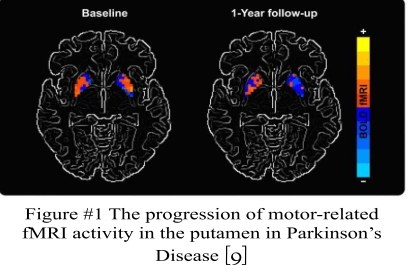
Parkinson’s disease is a long-term age-related degenerative disorder that significantly adversely affects the motor system [1]. It is caused by the progresssive loss of nerve cells in the part of the brain called the substantia nigra that is responsible for producing the neurotransmitter dopamine [1]. As shown in Figure #1, this is supported through the brain’s fMRI scan activity in the putamen (region containing substantia nigra nerve cells) before vs after Parkinson’s Disease. Dopamine, an essential neurotransmitter, plays a key role in control and coordination of body movement whilst simultaneously acting as a messenger in the peripheral nervous system. If the brain’s nerve cells become damaged or die, the breakdown of adequate dopamine levels occurs, causing a decrease in the brain’s ability to control movement and balance coordination and decreasing rates of movement.
Alongside coordination difficulties, the deterioration of substantia nigra nerve cells may also cause tremors in the limbs, slowness of movement and even memory loss [1]. However, PD can further affect unconventional aspects such as generalized communication skills that constitute non-verbal communicative skills (including facial expression, gestures, tone of voice, body language) and verbal communication skills (slur of words, excessive mumbling, slow speaking rate or accelerated speaking rate with stuttering) [1]. This impairment of non-verbal and verbal communication can cause numerous quality aspects of life to decrease such as interpersonal relationships, low mood, detachment from society, isolation and low socio perceptions [1]. The multitude of life-threatening symptoms has caused an amplitude of medical attention in researching new therapies and forms of coping alongside the challenges. Therapy interventions such as speech therapy has been generationally utilized to advance the communicative skills in individuals with PD, however, recent awareness has been placed on music intonation therapy and the effectiveness of this musical approach.
Music Intonation Therapy
Music Intonation Therapy is an evidence-based music therapy that uses intoning/singing to improve expressive language and clarity of speech production [2]. This process is one where certain phrases in a song are given to the PD individual where they are slowed down and sung to a steady beat until the individual is able to repeat it with clear enunciation [2]. This is when the music and melody is removed and the phrases are spoken in a standardized way, hence improving communication. To help this therapy program optimize its results, the singing of loved familiar songs is recommended to bring positive associations and memories that motivate the individual to continue and keep up with the words in the song [3]. Despite the familiarity and initial abstractivity of this approach, there is a strong neurobiological rationale in order to explain the speech improvement in PD.
Neurobiological Link Between MIT and Parkinson’s Disease
Due to Parkinson Disease’s nature of attacking the motor system in the brain, communicative deficiencies such as speech loss and sufficient verbalized production occur. With Intonation Music Therapy, this speech can be improved by treating the certain kinds of speech loss caused by brain deterioration in the left hemisphere [4]. This is done as speech is controlled predominantly in the left hemisphere in the Broca’s area whereas music is controlled primarily by the right hemisphere in conjunction with dispersion through both halves of the brain. If the primary speech center is deteriorated and impaired neural signaling is sent to the Broca’s area from the basal ganglia, therapy sessions can rework music neural networks to help relatively unused language centers located in the right hemisphere to develop and expand the connections needed for speech production. This allows the secondary language center to be utilized more in the right hemisphere and reduces the brain’s dependency on utilizing the left hemisphere.
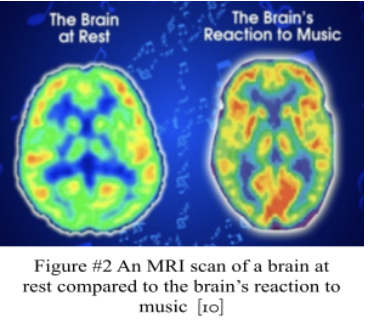
Moreover, the main section of the brain that is impaired with notable volume loss in PD individuals is the corpus callosum and music therapy can activate it, consequently promoting better language skills [5]. This is supported through figure #2, that illustrates an MRI scan of the brain at rest with low activation in comparison to its high activity reaction to music. In addition, due to the corpus callosum’s integral function of connecting the right and left hemispheres of the brain allowing information to be transferred between them, strengthening it will increase the fibers. Consequently, this allows an increase of information and electrical signals to be transferred per second [4]. This is crucial as the transfer of connections from both hemispheres can allow the individual to comprehend more complex communicative information and expressive language as the left hemisphere is responsible for language processing whereas the right hemisphere is responsible for creative skills such as verbal ambiguity and emotions. Moreover, Music Intonation Therapy can partially counteract the loss of dopamine neurons from the progressive nature of Parkinson’s Disease by replacing the neurons throughout the brain (especially in the left hemisphere) due to music’s natural ability to increase levels of dopamine in the brain.
Additionally, the neurobiological improvement in PD with music intonation therapy can be associated with the amygdala, which is located in the medial temporal lobe and is a cluster of nuclei that governs emotional memory, decision making, and emotional responses [4]. In PD, individuals have a smaller regional area and suffer from volume loss of the amygdala. Via music therapy, musical stimulations can increase amygdala activation which increases emotional cues and awareness [4]. This can aid in improved interactions with others, and an increase in the expression of emotions that can improve communication skills.
Verbal Communicative Skills
Despite the abundant neurological link that is present within music intonation therapy and Parkinson’s disease, it is crucial to evaluate and explore key studies to ensure there is a true cause and effect relationship with high internal validity. With the studies and biological link present, researchers are able to finalize and set the reliability of the efficacy in this type of therapy, and use it for future generations in the neurological field.
Primarily, the first study that is used to support the positive correlation between music therapy and PD is Haneishi et al 2001. This study’s aim was to examine the effect of music therapy on verbal communication skills including as speech intelligibility (how well someone can be understood while speaking), vocal intensity, maximum vocal range, vocal fundamental frequency and vocal fundamental frequency variability of individuals with Parkinson’s disease [6]. The procedure utilized included four female patients whose age ranged from 67-77 years, possessed voice and speech problems, and had PD [6]. They took three tests in three different conditions: baseline assessment for the control pretest group, a series of music therapy sessions involving singing and vocal exercises, and a final evaluation for the experimented posttest group [6]. Using T-tests, researchers found a statistically higher increase in speech intelligibility and vocal intensity, hence confirming the use of music therapy as an effective therapy for increasing verbal communication skills.
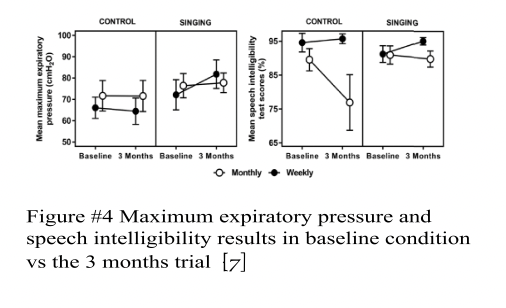
Another study by Tamplin et al 2019 is used to increase the data triangulation and thick research findings to support the increase in communicative skills. This study included using music therapy to investigate the voice, speech, and respiratory strength of 75 people with mild to moderate Parkinson’s Disease. The method included utilizing high effort vocal and respiratory tasks, speech and intonation exercises, and social communication in a naturalistic environment for over three months {7] . The results highlighted a significant improvement in maximum expiratory pressure (P= 0.032) and vocal intensity (P=0.018) which are all components intrinsically needed in verbal speech production in order for communication to increase {7] .
Non-verbal Communicative skills
Non-verbal communication consists of facial expressions, voice tones, body language and gestures. Many studies can be utilized to support that there is a positive correlation of using music therapy to improve Parkinson’s disease communicative skills. Primarily, Lotan et al 2012 aimed to evaluate the effect of group music therapy on facial expressions in individuals with PD. Independent group design split 10 participants with PD from a Rehabilitation Center in Norway into two groups where they met once a week for one hour music session for 20 minutes. The facial expression was measured using the facial mobility and engagement evaluation, alongside the Facial Action Coding System. In both groups, there was a positive increase in facial expression from the pre-test compared to the post-test condition, indicating successability in improving a sector of non-verbal communication.
Tamplin et al 2019 is another efficient study used in the verbal communication department to utilize for support in music therapy in non-verbal communication. This study described above demonstrates that music therapy increased the vocal intensity and tone in individuals with Parkinson’s disease in comparison to the control group, indicating the overall effectiveness.
Discussion
The results of the studies above are used to positively support the efficacy of Music Intonation therapy in communication difficulties in individuals with Parkinsons’ Disease. This conclusion is able to be reached due to the non-verbal and verbal array of communication skills that are enhanced such as vocal tone and intensity, sufficient articulation and intonation, ensuring every subsector of communication is evaluated. Despite the evidence in relation to the hypothesis, it is crucial to have a critical outlook on the studies utilized to ensure an evaluative standpoint can be reached and reliability is met. This credibility in the studies is needed to ensure the evidence that is presented has a clear correlative relationship with the aim of this research, which can allow accurate and representative deductions to be made. Primarily on verbal communication, Haneishi et al 2001 study has high method triangulation due to the utilization of a wide variety of dependent variables (such as vocal intensity, maximum vocal range etc.) to measure a single variable of effectibility in music therapy. The refined and abundant method approaches employed demonstrate the study’s high reliability and credibility, ensuring the results are accurate and are thoroughly consistent. However, due to the specificity and small range of the sample size including four females aged 67-77, this creates the inability to generalize the findings to a wider population as participant variability factors were not taken into account. This makes the research findings difficult to transfer in larger research settings, giving it a limited transferability to all individuals.
Tamplin et al 2019 has a variety of strengths and weaknesses to assess the reliability of the findings on verbal and non-verbal communicative skills. Immediately, high ecological validity (where findings can be generalized to a real-life setting ) is present due to the naturalistic setting and long duration of the study, ensuring the results aren’t artificial and unreliable. Moreover, the study used 75 individuals which allowed rich data to be gathered to ensure participant variability did not guide the findings and rather a clear cause and effect relationship of the independent and dependent variable is reached. Despite these strengths, there was no baseline assessment to the severity of Parkinson’s Disease each individual had as they were all categorized into one sector, illustrating a lack of the baseline control variable. This means it is not certain whether music therapy is effective for all types and severities of Parkinson’s Disease, reducing its ability to be successfully generalized.
Despite the specific evaluative factors in each study, both studies could have increased their credibility by increasing their range and variability of sample size and increase the ability to be generalized to a wider population. However, music intonation therapy as a relatively modern approach to Parkinson’s Disease contains further limitations as well that depend on participant variability. Primarily, music is a very subjective concept as some individuals naturally gravitate and utilize it as a support system daily, whereas others may never have that intrinsic emotional attachment. This can significantly affect the effectiveness of MIT on an individual as different populations may simply resonate with music and rhythm more, which can naturally have greater improvements and findings. Moreover, due to the specificity of every individual with their preferred music taste, some music therapy’s that contain only one unilateral music choice may not be effective as individualization is not considered. If the individual does not have a certain personal connection involved with the music, it is subconsciously more difficult for them to be susceptible to improvement. Therefore, this illustrates how objective music therapy can be in order for its true efficacy to be established, alongside future research to optimize the psychological approach used.
Overall, research in the field of music therapy is one that is constantly developing and expanding in modern medicine. However in spite of the success previous research has accomplished, it is always necessary to recognize areas of weaknesses in order for successive studies to be done with an even higher percent of accuracy. Within this realm of interdisciplinary study between music and biopsychology, it is crucial for research to be compared and completed cross-culturally to allow music therapy to be assessed on an international level with global variance. This can ensure that the findings of efficacy towards Music Intonation Therapy and Parkinson’s Disease is not just one that is accustomed to a westernized environment, and is applicable to all varying cultures. This is a significant sector of improvement that needs to be focused on as current research lacks centricity and is only explored significantly in western cultures. Moreover, throughout this region of research, future considerations could be made to have more baseline control variables such as the magnitude of Parkinson’s Disease present to ensure the results are consistent and reliable throughout, without any minor discrepancies that can hinder the quality of the study.
Conclusion
Overall, through key revolutionary studies such as Tamplin et al and Haneishi et al in conjunction with neurobiological links with music’s powerful effect on the brain circuit, the claim of music intonation therapy being an effective strategy to increase non-verbal and verbal communication skills in individuals with Parkinson’s disease is supported. Understanding the influential capability music has on these extreme neurological diseases is crucial to increase its prevalence in the medical realm and upcoming neurological research. This can allow a cumulative cultivation of reducing the severity and magnitude of Parkinson’s disease symptoms and increase these patient’s quality of life and ease. An evaluative standpoint with critiques, however,was incorporated into this research paper to ensure a balanced view and continued improvement in future research approaches.
–––––––––––––––––––––––––––––––––––––––––––––––––––––––––––––––––––––––––––––––––––
References
[1] NHS organization. (30/04/2019). Overview of Parkinson’s Disease. NHS. Page 1-2 https://www.nhs.uk/conditions/parkinsons-disease/causes/#:~:text=Parkinson%27s%20disease%20is%20caused%20by,producing%20a%20chemical%20called%20dopamine. Retrieved: 25/05/2022. |
|---|
[2] Andrea, Norton et al. (20/11/2009). Medical Intonation Therapy: Shared Insights on How it is done and Why it Might Help. The New York AcademySciences.https://www.ncbi.nlm.nih.gov/pmc/articles/PMC2780359/. Retrieved: 25/05/2002. |
[3] Zumbansen, Anna et al. (28/01/2014). Melodic Intonation Therapy: back to basics for future research. Frontiers in Neurology.https://www.frontiersin.org/articles/10.3389/fneur.2014.00007/full. Retrieved: 27/05/2022. |
[4] Sotomayor, Manuel et al. (18/11/2021). Music Therapy and Parkinson’s Disease: A Systematic Review from 2015-2020. Environmental Research and Public Health. https://www.ncbi.nlm.nih.gov/pmc/articles/PMC8582661/. Retrieved: 01/06/2022. |
[6] Haneishi, E (01/12/2001). Effects of a Music Therapy Voice Protocol on Speech Intelligibility and Vocal Acoustic Measures. Journal of Music Therapy. https://booksc.org/book/29661834/999d0a. Retrieved: 01/06/2022 |
|---|
{7] Tamplin, Jeanette (12/05/2019). ParkinSong: A Controlled Trial of Singing-Based Therapy for Parkinson’s Disease. Sage Journals. https://pubmed.ncbi.nlm.nih.gov/31081485/ .Retrieved: 15/06/2022 |
[8] Lotan, Meir. (01/11/2012). Effect of Music Therapy on Facial Expression of Individuals with Parkinson’s Disease. Sage Journals. https://journals.sagepub.com/doi/10.1177/1029864912458917.. Retrieved: 15/06/2022 |
[9] Lotan, Meir. (01/11/2012). Effect of Music Therapy on Facial Expression of Individuals with Parkinson’s Disease. Sage Journals. https://journals.sagepub.com/doi/10.1177/1029864912458917.. Retrieved: 15/06/2022 |