
Crystals are atoms arranged in a highly ordered lattice structure that extends in all direction. In other words, they are atomic structures that repeat in space(three dimensions). Diamond and salt are two examples of crystals. However, recent research efforts from Harvard University Scientists have lead to the creation of a new type of matter called time crystals. Time crystals are atomic structures that repeat in space and time(four dimensions). That means that time crystals have a repeating structure in space that will change and repeat as time passes.
Time crystals have been hypothesized back in 2012 by Nobel-Prize-Winning physicist Frank Wilczek. He envisioned it as a type of matter that have movement even it its ground state. Normally, matter tend to reach thermal equilibrium over time and stay there. When matter is in its ground state, it reaches thermal equilibrium and all of its atoms have the same amount of energy. Movement is theoretically impossible at this state. So when energy is passed through matter “in equilibrium”, it will travel through the atoms and eventually leave the system(diagram 1). However, time crystals belong to a new class of matter called “non-equilibrium phases”, which means that their ground state is not in thermal equilibrium. This is because some of time crystals’ atoms are entangled with one another and when energy enters the system it causes fluctuations in the quantum states of the crystal’s atoms that repeats in time(diagram 2).
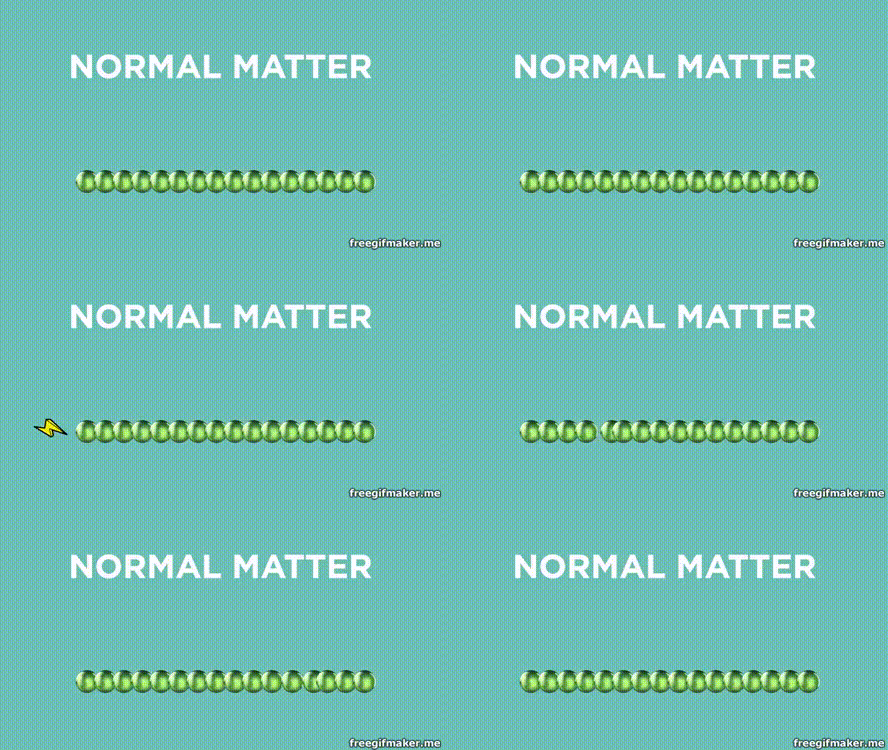
How normal matter behave when energy enters the system. (Source: Joe Scott)
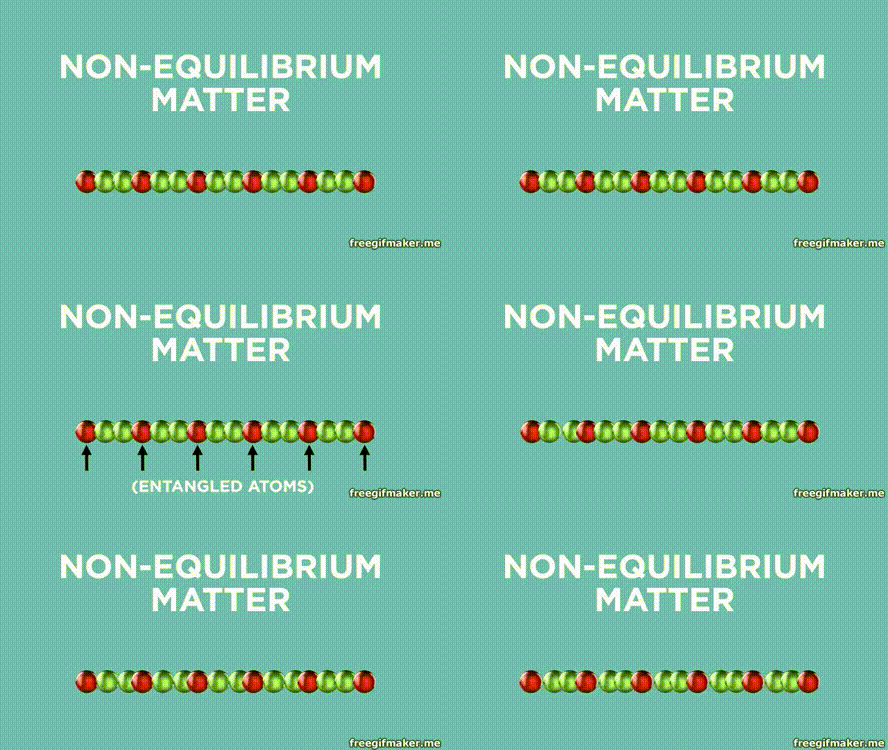
How non-equilibrium matter reacts when energy enters the system. (Source: Joe Scott)
At first glance, the properties of time crystals violates many physics laws. For example, one of the most fundamental symmetries in physics: the time-translation symmetry, is broken by time crystals. Time-translation symmetry states that physics laws will be constant regardless of position in space or location in time. Time crystals break this symmetry because its atoms’ “preferred” states change throughout different intervals in time. However, it is proposed that this symmetry breaking is a “spontaneous symmetry breaking”, meaning that the symmetry is not wrong, unable to explain the universe in full.
Many potential applications of time crystals exist, but the most exciting one is on quantum computing. Quantum computers use qubits(state of a subatomic particle) to store information. However, existing qubit storage device can only function properly when cooled to close to absolute zero. Time crystals might open the possibility to store qubits stably in higher temperatures due to their unique properties.
Time crystals and other forms of exotic matter has challenged scientists’ understanding of the nature of matter. We still know very little about their properties but with more research, maybe one day they will be integrated into technology and change the world beyond our imaginations.
Bibliography
Crew, Bec. “It’s Official: Time Crystals Are a New State of Matter, And Now We Can Create Them.” ScienceAlert, http://www.sciencealert.com/it-s-official-time-crystals-are-a-new-crazy-state-of-matter-and-now-we-can-create-them.
“Is there any reason behind the spontaneity of spontaneous symmetry breaking?” Researchgate, 2014, https://www.researchgate.net/post/Is_there_any_reason_behind_the_spontaneity_of_spontaneous_symmetry_breaking
MacDonald, Fiona. “Scientists Have Confirmed a Brand New Phase of Matter: Time Crystals.” ScienceAlert, http://www.sciencealert.com/scientists-have-just-announced-a-brand-new-form-of-matter-time-crystals.
“Quantum Field Theory: What is spontaneous symmetry breaking?” Quora, 5 May 2014, https://www.quora.com/Quantum-Field-Theory-What-is-spontaneous-symmetry-breaking
“Researchers Create ‘Time Crystals’ Envisioned by Princeton Scientists.” Phys.org – News and Articles on Science and Technology, phys.org/news/2017-03-crystals-envisioned-princeton-scientists.html.
“Scientists Create New Form of Matter: ‘Time Crystal’.” ScienceDaily, ScienceDaily, 8 Mar. 2017, http://www.sciencedaily.com/releases/2017/03/170308131228.htm.
Scott, Joe. “Time Crystals Explained | Answers With Joe.” YouTube, YouTube, 28 Feb. 2017, http://www.youtube.com/watch?v=ucwmGZ51X7E.