
This is part two of the two-part series: The Biochemical Circle of Life. Part 1 can be found here.
In part 1, the methods in which photosynthesis harnesses the power of light and turn it into chemical energy stored in glucose is discussed. But how can organisms efficiently extract that energy from glucose to sustain life? The answer is cellular respiration. Cellular respiration is a biochemical process all organism undergoes to release the energy stored in sugar. By breaking the carbon-carbon bonds in glucose, energy is released and used to phosphorylate ADP into ATP, which can then go on and power other cellular processes. Cellular respiration can happen both aerobically(with Oxygen) and anaerobically(without Oxygen). Aerobic respiration requires mitochondria, produces a lot more energy than anaerobic respiration, and is carried out by eukaryotes and some prokaryotes; anaerobic respiration does not require organelles, produces less energy, and are typically carried out by prokaryotes.
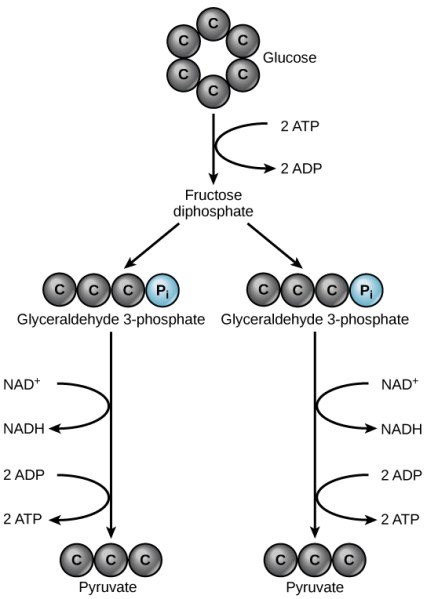
Diagram 1: Glycolysis (Source: BC Open Textbooks)
Both aerobic and anaerobic respiration starts with glycolysis, the splitting of glucose into two three-carbon molecules called pyruvate[Diagram 1]. In the first step of glycolysis, glucose(6 carbon sugar) is phosphorylated two times into a hexose bisphosphate(six-carbon sugar with two phosphate groups attached). The hexose bisphosphate is unstable and splits into two triose phosphate. Next, a series of redox reactions phosphorylates the triose phosphates into triose bisphosphate and two NAD+ molecules are reduced to NADH + H+ in the process. Finally, the two triose bisphosphate are converted into pyruvates and four ADP is phosphorylated in the process. This gives glycolysis a net ATP production of 2.
If oxygen and a mitochondrion is present, the pyruvate will be transported to the matrix of the mitochondrium and undergo the link reaction, also called pyruvate decarboxylation [diagram 2]. Each pyruvate undergoes a redox reaction that removes one CO2 molecule and reduces another NAD+ molecule. The carbon dioxide is excreted and the now two-carbon molecule, Acetaldehyde, bonds with an enzyme called coenzyme A to form Acetyl CoA.
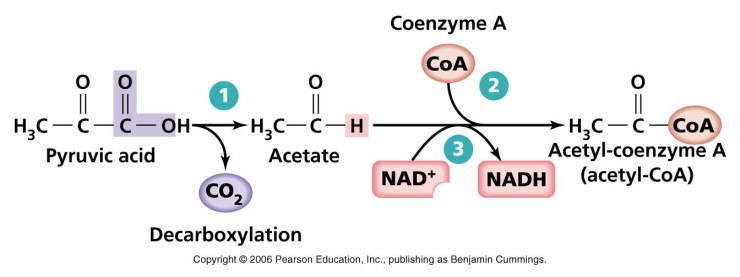
Diagram 2: Link Reaction (Source: PGCC)
The Acetyl CoA molecule then enters the Krebs Cycle, also called the Citric Acid Cycle [diagram 3]. The two-carbon acetaldehyde bonds with a four-carbon molecule (Oxaloacetate) and a six carbon molecule (citric acid) is formed. Then, many rounds of redox, phosphorylation, and decarboxylation reactions remove two carbon in the form of CO2 from citric acid and turns it back into oxaloacetate. In the process, many electron carriers such as NAD+ and FAD is reduced and some ATP is also produced. If observed carefully, one will realize that the Krebs Cycle very similar to the Calvin cycle except it is going backward. That is, the Krebs cycle removes CO2 to gain energy while the Calvin Cycle adds CO2 to store energy.
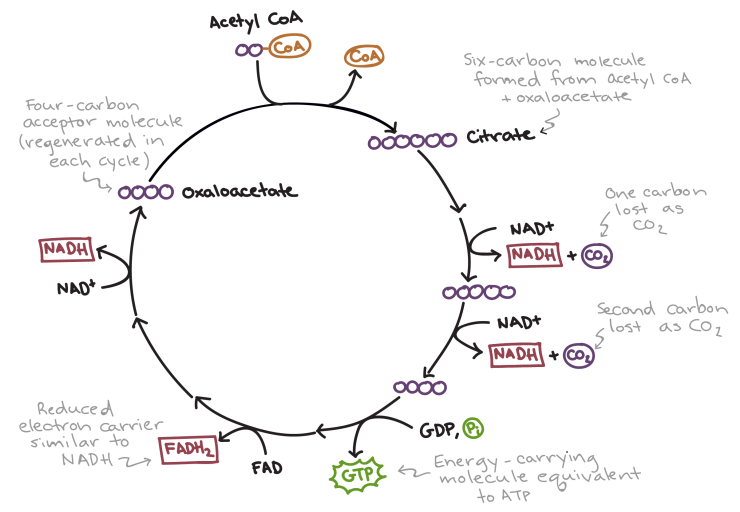
Diagram 3: The Citric Acid Cycle (Source: Khan Academy)
At this point, the energy from the carbon-carbon bonds have been released as some ATP and high-energy electrons carried by NADH or FADH2. The next step in cellular respiration is the electron transport chain(ETC) [Diagram 4], where the majority of the ATP production will happen. The electron carriers release electrons and H+ ions. The excited electrons are passed through several proteins that harness their energy as it returns to a lower-energy state to pump H+ ions across the inner membrane of the mitochondrium into the intermembrane space, creating a concentration gradient. The electrons then bond with oxygen from breathing and H+ ions from the matrix to form water. The oxygen, in this case, is called the Terminal Electron Acceptor and is critical for aerobic respiration to happen. If oxygen is absent, the ETC and therefore the Calvin cycle will both be halted. Then, the H+ concentration gradient is used to conduct chemiosmosis. This is called oxidative phosphorylation and is where most of the ATP from cellular respiration is from. The theoretical net yield of cellular respiration is 38 ATP per glucose molecule although factors such as energy lost to heat or energy used for transport means the actual value is around 34. Once again, the ETC in cellular respiration shares many common characteristics with the ETC in photosynthesis. The biggest difference is that the former oxidizes electron carriers and form water while the ladder breaks water and reduces electron carriers.
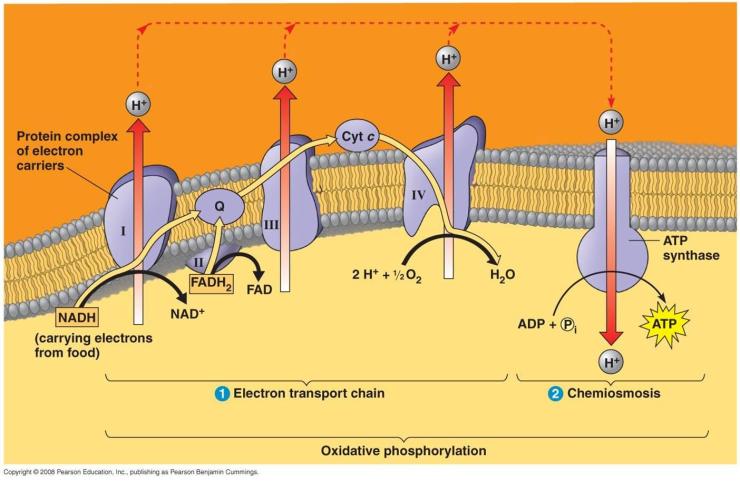
Diagram 4: Oxidative Phosphorylation (Source: Iron Age)
However, respiration can also be carried out aerobically in some cases. There are two major types of aerobic respiration: anaerobic respiration carried out by anaerobes, microorganisms that can survive without oxygen, and anaerobic respiration that aerobic organisms are forced to carry out in oxygen-deficient environments. In the former case, some anaerobes are capable of carrying out anaerobic respiration in a similar manner as aerobic respiration, molecules such as nitrates and iron ions substitute oxygen as the terminal electron acceptor and the Calvin cycle is skipped due to the lack of mitochondria[Diagram 5]. In the latter case, the pyruvic acid from glycolysis is converted to ethanol or lactic acid to regenerate the NAD+ that is reduced in glycolysis. The soreness you feel when sprinting or performing intensive exercise is the buildup of lactic acid in your muscle cells as they are forced to respire anaerobically due to the insufficient amount of oxygen to satisfy the high energy demand. The same chemical is also responsible for the sour taste of yogurt. These types of anaerobic respiration are often called fermentation and generate a lot less energy, only 2 ATP per molecule of glucose.
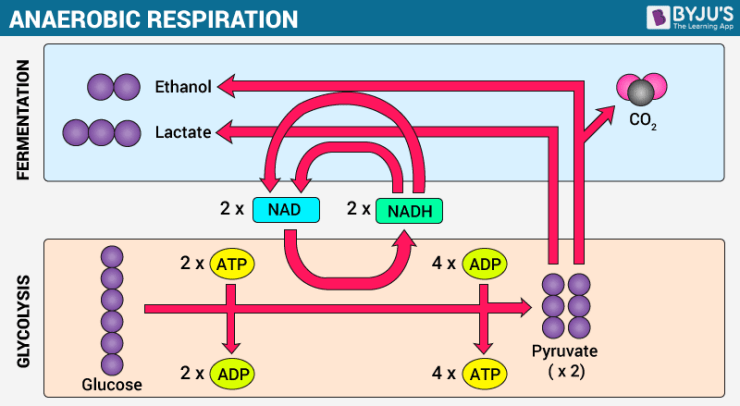
Diagram 5: Anaerobic Respiration/Fermentation (Source: Byju’s)
In a nutshell, cellular respiration is the complement photosynthesis. The reactants of cellular respiration are the products of photosynthesis and vice versa. Together, they power the “circle of life” where the input is sunlight and output is energy in the form of ATP.
This is part one of the two-part series: The Biochemical Circle of Life. Part 1 can be found here.
Bibliography
Cellular Respiration, hyperphysics.phy-astr.gsu.edu/hbase/Biology/celres.html.
Coniel, Oscar. “Cellular Respiration.” IB Biology Notes, ibguides.com/biology/notes/cell-respiration-hl.
Boundless Biology. “The Citric Acid (Krebs) Cycle.” Lumen Learning, Lumen, courses.lumenlearning.com/boundless-microbiology/chapter/the-citric-acid-krebs-cycle/.
“Link REactionl.” Higher Level | BioNinja, ib.bioninja.com.au/higher-level/topic-8-metabolism-cell/untitled/link-reaction.html.
“Electron Transport Chain (ETC)- Components and Steps.” Microbiology Notes, 7 Aug. 2018, microbenotes.com/electron-transport-chain-etc-components-and-steps/.
“Glycolysis.” Khan Academy, Khan Academy, http://www.khanacademy.org/science/biology/cellular-respiration-and-fermentation/glycolysis/a/glycolysis.