
The mystery of life is one that has fascinated scientists for centuries and there has been numerous attempts to explain the age-old question of how life has originated on Earth. For example, panspermia is the idea that life originated from an asteroid carrying microorganisms that hit Earth, and primordial soup is another that argues that the inorganic chemical condition of early Earth can synthesize organic matter that lead to life under energy sources like sunlight and lightnings and heat-baths like the ocean. The RNA world hypothesis is one that hypothesizes that chains of RNAs, or Ribonucleic Acids, gave rise to life and are the first things on this planet to exhibit lifelike qualities such as reproduction, interaction with the surrounding, and evolving over time.
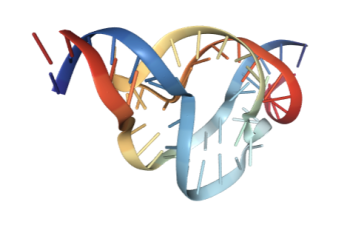
The structure of a ribozyme named 3ZD5(Source: Protein Data Bank)
RNA is a type of single strand genetic material similar to DNA. RNA consists of a sugar-phosphate backbone connected to nitrogenous bases. RNA’s building blocks are called nucleotides. A nucleotide is a chunk of RNA’s backbone connected to one of the four bases, Adenine, Uracil, Guanine, or Cytosine. RNAs can create copies of themselves via a process called “base pairing”, where the bases on an existing strand of RNA attracts bases of nucleotides in the RNA’s surroundings. Weak bonds form between Adenine and Uracil; and Guanine and Cytosine, and the result is the formation of a complementary strand of the original RNA. However, mistakes in base pairing can sometimes happen and cause a slight difference in the two strands of RNA.
When there isn’t enough nucleotides in the RNA’s environment, something far more interesting happens: RNA strands base pair with themselves. They form complex folded structures with paired bases pointing inwards and unpaired bases pointing outwards. Some of these strands of folded RNA, similar to enzymes, have the ability to host and catalyze a range of chemical reactions, including the production of nucleotides; these unique RNA strands are are called ribozymes. It has also been observed that in iron rich environments, some ribozymes can even host photosynthesis and cellular respiration, acting like simplified versions of Chloroplasts or Mitochondria.
Evolution takes over at this point, ensuring the survival of RNA strands with the most efficient mechanisms to survive and reproduce. After thousands of generations of survival of the fittest for RNAs, some start to protect themselves from external threats by constructing a protective membrane layer around them - the first cells are born. After that, it’s the story that everyone of us has heard a thousand times on the evolution of prokaryotes into eukaryotes and then complex life.
Bibliography
Exploring Life’s Origins: Ribozymes & the RNA World, exploringorigins.org/ribozymes.html.
DNewsChannel. “Bold New Theory On The Origin Of Life.” YouTube, YouTube, 19 Dec. 2014, http://www.youtube.com/watch?v=DpuHOqbDjoc.
DNewsChannel. “How Did Life Begin?” YouTube, YouTube, 29 May 2013, http://www.youtube.com/watch?v=ofFhHcvasHA.
“The RNA Origin of Life.” PBS LearningMedia, http://www.pbslearningmedia.org/resource/nvra.sci.origin/the-rna-origin-of-life/#.W3941JMzaqA.
“RNA Was a Key Ingredient in Primordial Soup That Led to Life.” Los Angeles Times, Los Angeles Times, 20 May 2013, http://www.latimes.com/science/sciencenow/la-sci-sn-rna-life-20130519-story.html#.
crashcourse. “Life Begins: Crash Course Big History #4.” YouTube, YouTube, 8 Oct. 2014, http://www.youtube.com/watch?v=1WS712DHfmg.
sciencestatedclearly. “What Is the RNA World Hypothesis?” YouTube, YouTube, 30 Aug. 2016, http://www.youtube.com/watch?v=K1xnYFCZ9Yg.