
Imagine a computer with so much computing power it can predict the future by analyzing every single detail of reality. This might sound like science fiction, but humanity is closer than you think in doing so, and the key to all this are quantum computers. Quantum computers are computers that exploits unique properties of subatomic particles to perform intensive calculations with large amount of data in much faster ways.
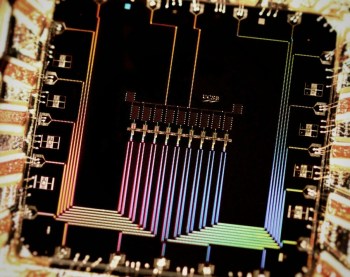
A 9-qubit quantum chip (Source: UCSB)
The basic unit for data storage and processing in traditional computers is called a bit, which is basically an electrical switch that can either be set to 1(on) or 0(off). However, this is not the case for quantum computers. Quantum computers use qubits(in short for “quantum bits”) as their basic unit. Unlike bits, qubits are subatomic particles that can be set to 0, 1, or mix of 1 and 0, which is called a superposition. One can’t really know the value represented by a qubit until an observation is made and the superposition is forced to collapse into a definitive state. Bits can be viewed as a coin that is either heads or tails and qubits can be viewed as spinning coins that represents both heads and tails at the same time.
Advertisement
This unique property of qubits enable them to store way more information than bits. n bits can store only one out of the 2n possible combinations of n 1s and 0s at a time while n qubits can store every one of the 2n possible combinations at the same time. For example, 10 bits can store 1 out of 1024 possible values while 10 qubits can store all of the 1024 possible values at once. A quantum computer with 50 qubits can store more data than the largest supercomputer in the world, and the amount of different values 300 qubits can store is more than the amount of atoms in the universe. Qubits can store so much information that some scientists argue that a 400-qubit computer directly challenges the cosmological information bound, the maximum amount of information that can be contained in a finite amount of space.
Traditional computers uses logic gates to perform mathematical processing on the inputs. Even though it may sound counterintuitive, addition in math can be actually be represented by a couple of AND, OR, and XOR logic gates feeded with inputs of ones and zeros. Quantum computers, however, uses quantum gates to manipulate inputs in the form of a superposition and return a new superposition in a process called qubit manipulation. Entanglement is also another key property of qubits. It is where the state of a qubit can be directly deduced by observing the state of another qubit that is entangled with it. These special operations allows quantum computers to perform extensive calculations on large amount of data.
Being able to store ones and zeros instead of ones or zeros makes quantum computers excel at performing tasks such as physics simulation, password cracking, and database searching that have high computational cost traditionally. For example, if traditional computers are asked to search for an item in a database of size m, the computer will take on average m/2 rounds of searching before reaching that item. However, quantum computers, using their advantage on being able to run the search algorithm on every single entry in the database at once only needs on average log2m rounds of searching. This makes the quantum computers take roughly the square root of the time conventional computers take to perform the same task.
Currently, international technology companies such as Intel, Microsoft, and IBM, have achieved small-scale success of building quantum chips with dozens of qubits. Even though humans still have a long way to reaching commercialized quantum computers, quantum computers will likely become a reality in our lifetime given the exponentially growing technological advancements.
Bibliography
Beall, Abigail, and Matt Reynolds. “What Are Quantum Computers and How Do They Work? WIRED Explains.” WIRED, WIRED UK, 16 Feb. 2018, http://www.wired.co.uk/article/quantum-computing-explained.
Bekenstein, Jacob D. “Universal Upper Bound on the Entropy-to-Energy Ratio for Bounded Systems.” Physical Review D, vol. 23, no. 2, 1981, pp. 287–298., doi:10.1103/physrevd.23.287.
“Binary Adder and Binary Addition Using Ex-OR Gates.” Basic Electronics Tutorials, 28 Jan. 2018, http://www.electronics-tutorials.ws/combination/comb_7.html.
“Can We Predict the Future Using the Quantum Computer Simulation of the Real Universe?” Quora, http://www.quora.com/Can-we-predict-the-future-using-the-quantum-computer-simulation-of-the-real-universe.
Advertisement
Davies, Paul. The implications of a holographic universe for quantum information science and the nature of physical law. Researchgate.net, 2018.
“How Does Quantum Computing Work?” Euler’s Polyhedron Formula, 26 Nov. 2015, plus.maths.org/content/how-does-quantum-commuting-work.
“New Quantum Algorithm May Help AI to Predict Future: Study.” Quotable Quotes on Belt and Road from World Intellectual, Business Personnel – Xinhua | English.news.cn, http://www.xinhuanet.com/english/2018-02/03/c_136945485.htm.
Nielsen, Michael A., and Isaac L. Chuang. Quantum Computation and Quantum Information. Cambridge University Press, 2017. ISBN: 978-1-107-00217-3.